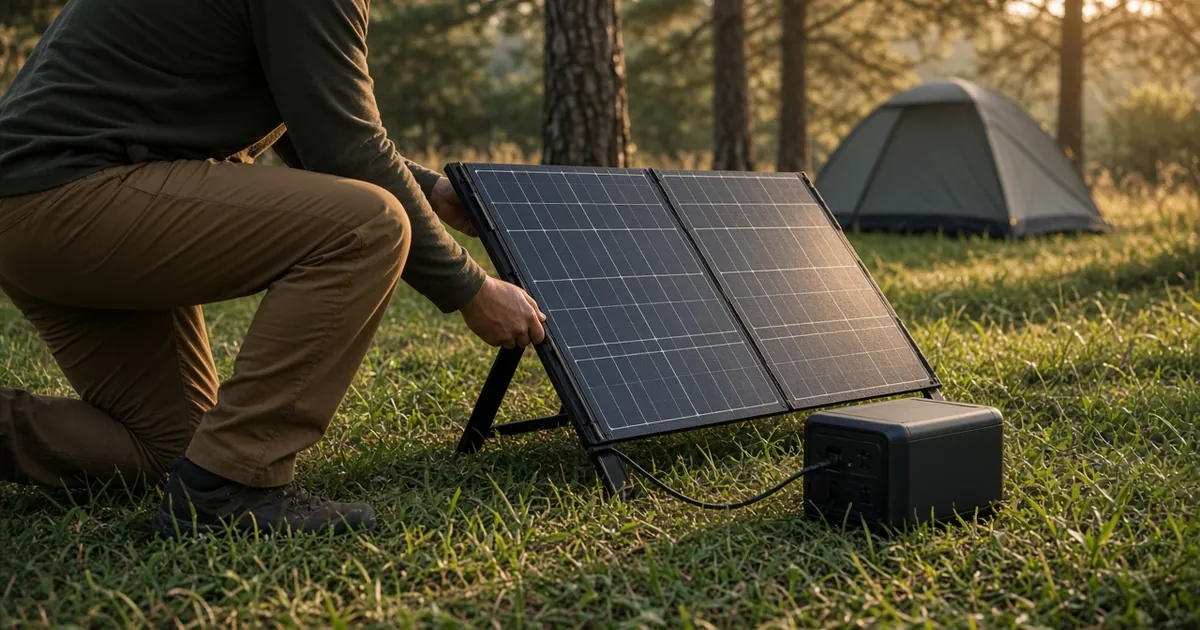
Short answer: To calculate the best angle for solar panels by ZIP code, look up the ZIP code’s latitude; the ZIP itself doesn’t have its own solar angle. For a fixed panel in the continental US, a common starting point is a tilt equal to your latitude, facing true south. Measured data often puts the best fixed annual tilt a few degrees flatter than latitude. For seasonal adjustment, a common rule of thumb is about latitude + 15° in winter and latitude − 15° in summer. A portable panel charging a power station is easier: aim it straight at the sun and watch the solar input reading.
How to find your solar panel angle by ZIP code
- Get the latitude of your ZIP code. Enter the ZIP in any map app or geocoder and read the latitude of a point in that area. Rounding to the nearest whole degree is fine. Across one ZIP code, the change in latitude is too small to matter for panel tilt.
- Set the annual starting tilt to about your latitude. The U.S. Department of Energy says that to get the highest annual output, modules in the northern hemisphere point due south and tilt at an angle equal to the local latitude. Tilt is measured from horizontal: 0° is flat, 90° is vertical.
- Check it against a model for your exact spot. Free tools like the EU’s PVGIS can work out an optimal fixed slope for any coordinates, using local weather and horizon data. That number is often a little flatter than latitude (see the table below).
- Decide whether you’ll adjust it. If you’ll change the angle a few times a year, use the seasonal angles. If not, keep the annual angle.
- Let the site decide the rest. Shade, roof pitch, wind exposure and the mounting hardware’s limits matter more than a couple of degrees.
Already know your latitude? Type it into the calculator below to get the year-round, winter and summer starting tilts. The table after it lists the same numbers for major US cities.
Solar panel angle calculator (by latitude)
Rule of thumb, not a design value: year-round = latitude, winter = latitude + 15°, summer = latitude − 15° (kept between 0° and 90°). Face the panel toward true south.
Solar panel angle table: major US cities
The latitudes below are approximate city-center coordinates. “Rule of thumb” uses tilt = latitude for the year, +15° for winter and −15° for summer. The “PVGIS optimum” column is the fixed, south-facing slope that PVGIS 5.3 calculated for those coordinates on October 11, 2026, using its ERA5 radiation data and built-in horizon. Treat every number here as a starting point, not a design value.
| City | Approx. latitude | Annual tilt (≈ latitude) | PVGIS optimum, fixed annual | Winter tilt (lat + 15°) | Summer tilt (lat − 15°) |
|---|---|---|---|---|---|
| Honolulu, HI | 21.3° N | 21° | 21° | 36° | 6° |
| Miami, FL | 25.8° N | 26° | 26° | 41° | 11° |
| Houston, TX | 29.8° N | 30° | 28° | 45° | 15° |
| Dallas, TX | 32.8° N | 33° | 32° | 48° | 18° |
| Phoenix, AZ | 33.5° N | 33° | 34° | 48° | 18° |
| Atlanta, GA | 33.8° N | 34° | 33° | 49° | 19° |
| Los Angeles, CA | 34.1° N | 34° | 32° | 49° | 19° |
| Charlotte, NC | 35.2° N | 35° | 34° | 50° | 20° |
| Nashville, TN | 36.2° N | 36° | 34° | 51° | 21° |
| Las Vegas, NV | 36.2° N | 36° | 36° | 51° | 21° |
| Washington, DC | 38.9° N | 39° | 37° | 54° | 24° |
| Denver, CO | 39.7° N | 40° | 40° | 55° | 25° |
| Philadelphia, PA | 40.0° N | 40° | 38° | 55° | 25° |
| New York, NY | 40.7° N | 41° | 38° | 56° | 26° |
| Salt Lake City, UT | 40.8° N | 41° | 38° | 56° | 26° |
| Chicago, IL | 41.9° N | 42° | 36° | 57° | 27° |
| Boston, MA | 42.4° N | 42° | 40° | 57° | 27° |
| Minneapolis, MN | 45.0° N | 45° | 41° | 60° | 30° |
| Portland, OR | 45.5° N | 46° | 37° | 61° | 31° |
| Seattle, WA | 47.6° N | 48° | 39° | 63° | 33° |
| Anchorage, AK | 61.2° N | 61° | 49° | 76° | 46° |
How to read it: In sunny, low-latitude places the modeled optimum lands right on latitude. Farther north, and especially in cloudier places like Seattle, Portland and Chicago, it drops well below latitude. That’s because summer days are long and winter skies are often overcast, so a flatter panel that favors summer collects more over the year. If your town isn’t listed, use the nearest city at a similar latitude and climate, or run your own coordinates in PVGIS.
Seasonal tilt adjustment
The sun rides higher in summer and lower in winter, so a panel you can re-angle can be steeper in winter and flatter in summer:
- Winter (roughly November to February): about latitude + 15°.
- Summer (roughly May to August): about latitude − 15°.
- Spring and fall: about latitude.
This ±15° rule is the convention behind NREL’s classic Solar Radiation Data Manual for Flat-Plate and Concentrating Collectors. That manual tabulated south-facing output at 0°, latitude − 15°, latitude, latitude + 15° and 90° for US sites. Treat the rule as an approximation, not an optimum. Some analyses suggest the best summer angle is flatter than latitude − 15°. And as the table shows, local weather pulls the year-round optimum lower than latitude in many places. If you adjust only twice a year, steeper for the cold months and flatter for the warm months already gets you most of the seasonal benefit.
Solar panel direction (azimuth) by ZIP code
- Everywhere in the 50 states, a fixed panel should face roughly true south. DOE’s guidance for the northern hemisphere is due south.
- True south is not magnetic south. A compass points to magnetic north, and depending on where you live, magnetic and true north can differ by a noticeable number of degrees. A map app with a satellite view, or a phone compass app set to true north, gets you closer.
- Azimuth numbers depend on the tool. PVGIS measures azimuth relative to due south: 0° is south, −90° is east and +90° is west. Many US tools measure clockwise from north instead, so south is 180°. Check which convention a calculator uses before you type a number in.
- East or west roofs still work. They just produce less than an ideal south-facing plane. When the roof decides the direction, tilt matters less than avoiding shade.
Portable solar panels and power stations: tilt in practice
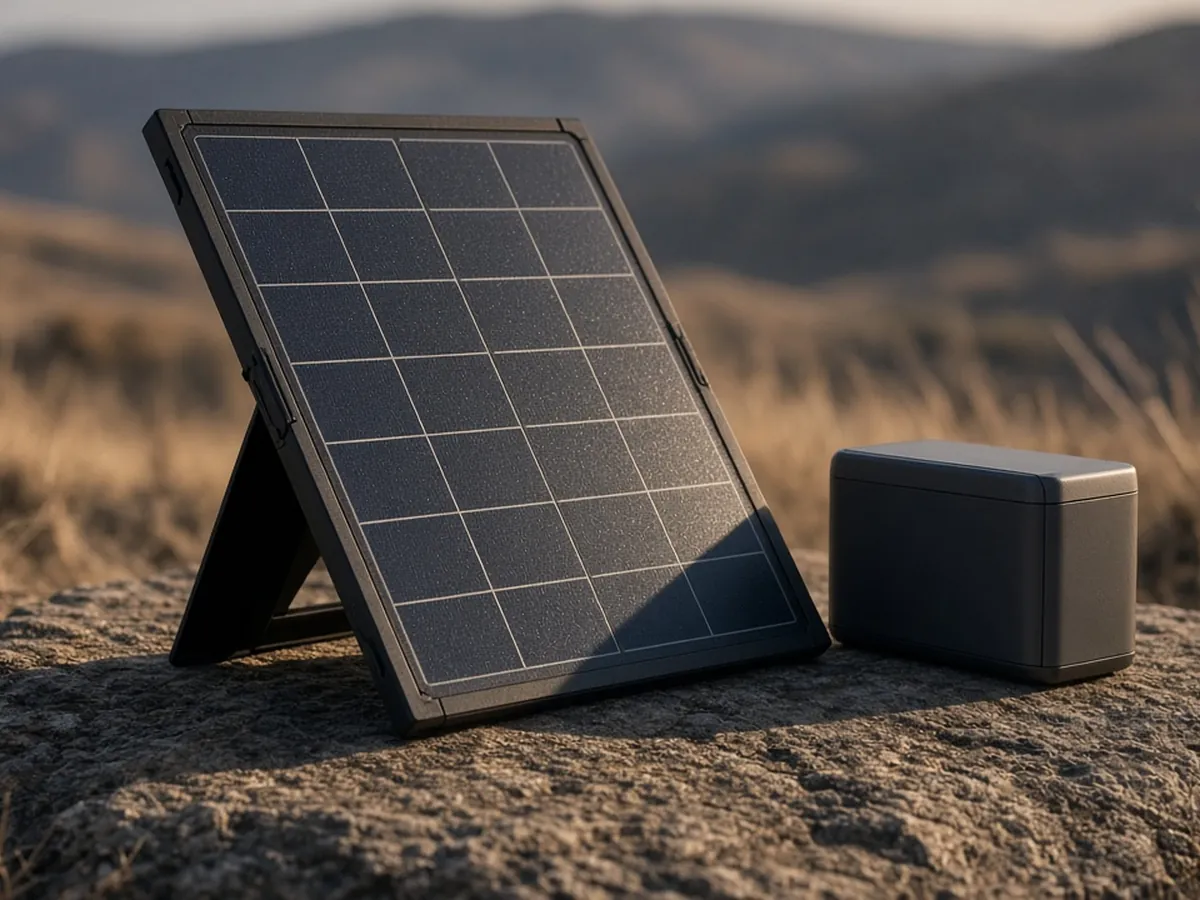
The latitude rule is for panels bolted in place. A folding panel feeding a portable power station can be moved, so the best angle is simply the one that points it most directly at the sun right now:
- Point the panel’s face at the sun. A handy check is the panel’s shadow: when it’s as small as you can make it, and the shadow of the kickstand falls straight behind the panel, you’re close.
- Watch the station’s solar input display. Change the angle in small steps and give the reading a few seconds to settle after each one. Keep the position that gives the highest steady number.
- Re-aim every couple of hours. The sun moves east to west through the day. A morning setup aimed southeast will be off by early afternoon.
- Use steeper angles in winter and in the morning or evening. Use flatter angles around midday in summer.
- Stay safe and stable. Use the stand the maker supplies, weigh or stake it down in wind, and route the cable where nobody trips over it.
- Avoid partial shade. A shadow from a branch or a car mirror across part of the panel can cut output sharply, often more than a bad angle does.
For setup, cables and input limits, see how to charge a portable power station with solar panels. If you’re adding a second panel, read solar panels in series or parallel first. If the input reading stays low even when the panel is well aimed, work through the solar panel troubleshooting guide.
Common angle mistakes
- Treating a ZIP code as an exact coordinate. It’s an area. A nearby latitude is all you need.
- Confusing roof pitch with panel tilt. On a flush roof mount, the roof pitch is the tilt. Changing it involves racking and structural and permit considerations, so talk to an installer.
- Aiming at magnetic south. Use true south.
- Using a rooftop number for a portable panel. Aim a portable panel at the sun and trust the input reading.
- Chasing degrees while ignoring shade. A few degrees off ideal costs far less than a shaded corner.
Frequently asked questions
What is the best solar panel angle by ZIP code?
Find your ZIP code’s latitude and use it as the starting tilt for a fixed, south-facing panel. For a more precise figure, enter the coordinates in a model like PVGIS. In many northern or cloudy US locations, its fixed annual optimum comes out several degrees flatter than latitude.
What is the best angle for solar panels in my area?
For a year-round fixed panel, start at about your latitude. If you adjust it seasonally, go about 15° steeper in winter and about 15° flatter in summer. Then let shade and mounting limits decide the final angle.
Which direction should solar panels face in the US?
Roughly true south, for fixed panels anywhere in the US. East- or west-facing panels still generate power, just less than a south-facing plane.
How do I find solar panel direction by ZIP code?
Direction doesn’t change with ZIP code within the US: aim for true south. Use a map’s satellite view or a phone compass set to true north, because magnetic south can be off by several degrees depending on where you are.
Should I change my solar panel angle with the seasons?
If your mount makes it easy, yes. A common rule is latitude + 15° in winter and latitude − 15° in summer. If your panels are fixed to the roof, the annual angle is fine.
What angle should a portable solar panel be for a power station?
Whatever angle points it straight at the sun at that moment. Adjust in small steps and keep the position with the highest solar input reading on the power station. Re-aim every couple of hours.
Is a flat solar panel bad?
A flat panel still produces power, especially in summer at low latitudes, but it usually collects less than a tilted one over the year. It also sheds dust, rain and snow poorly, so even a modest tilt helps.
Sources
- U.S. Department of Energy: Solar Photovoltaic System Design Basics. Fixed modules in the northern hemisphere: due south, tilt equal to latitude for highest annual output. Fetched 2026-10-11.
- European Commission JRC: PVGIS 5 user manual. Slope definition, azimuth convention (0° = south, −90° = east, 90° = west), optimal slope option. Fetched 2026-10-11.
- PVGIS 5.3 API (
PVcalc,optimalinclination=1,aspect=0, PVGIS-ERA5), run 2026-10-11 for the city coordinates in the table. - Harlan Bengtson, Bright Hub Engineering: Estimate Solar Radiation on Tilted Solar Panels. Describes the NREL Solar Radiation Data Manual tilt set (latitude ±15°) and the seasonal rule of thumb. Fetched 2026-10-11.