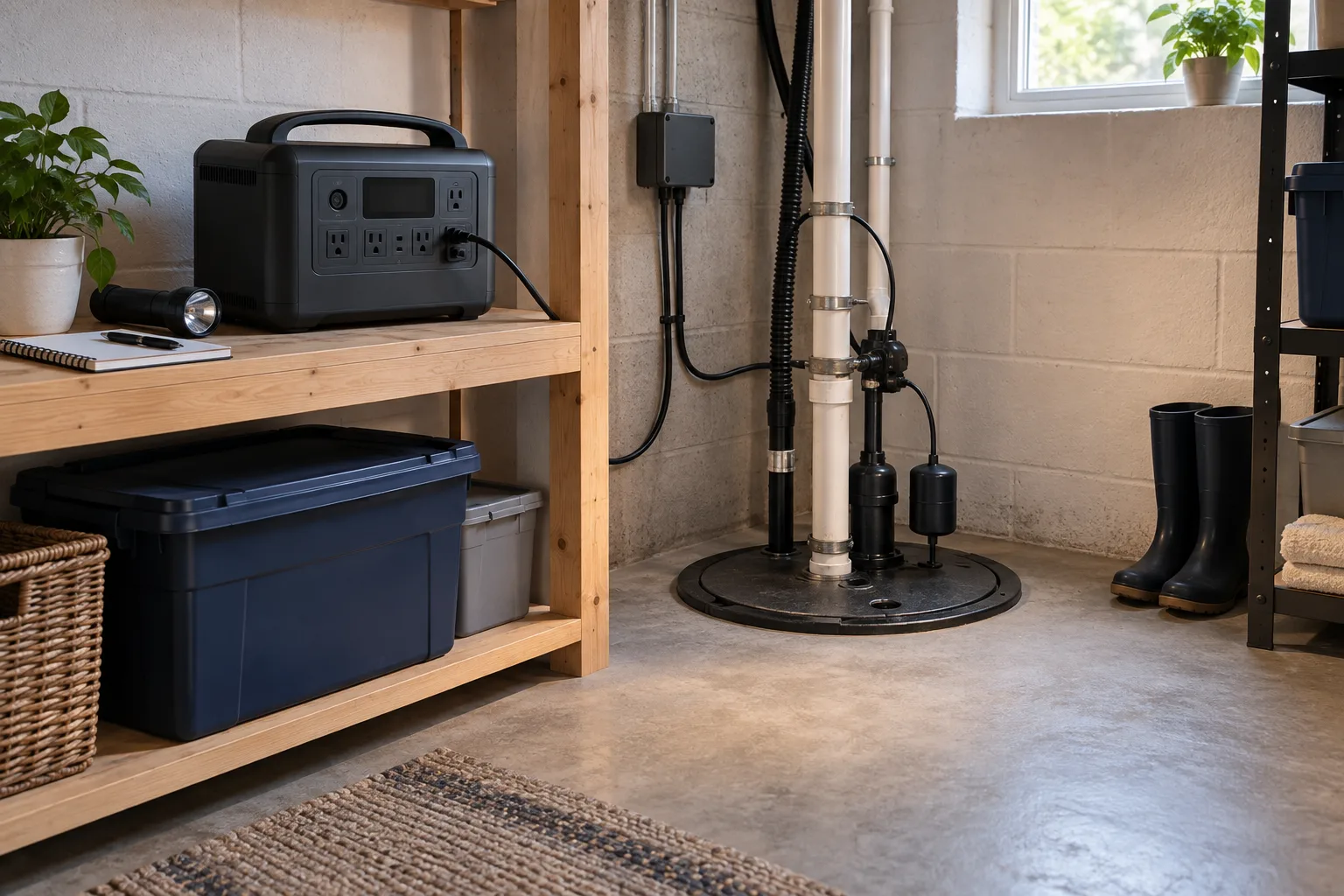
The critical question is “will it start?”
A pump may draw a modest amount once running and still need a much larger short surge to start. Compare the pump’s nameplate or measured startup event with the power station’s continuous and peak specifications. If the station cannot start the pump in a controlled test, do not treat it as a backup just because its running wattage looks low.
Sump-pump sizing workflow
- 01Identify the pump. Record voltage, horsepower if shown, running amps/watts and any manufacturer startup guidance.
- 02Measure if possible. A suitable power-quality meter can capture startup behavior that a basic plug meter may miss. Treat the manufacturer’s limits as the authority.
- 03Check the station. Verify AC voltage, continuous output, surge output and the stated surge duration. Some “boost” features change the voltage or behavior and may not be appropriate for a motor.
- 04Estimate cycling. A pump that starts every few minutes uses energy differently from one that runs continuously. Build a conservative range around your site conditions.
- 05Test the complete path. Include extension cord length, GFCI/protection, the pump, float switch behavior and any other connected load. Test under supervision and do not defeat safety devices.
Runtime is a cycling problem
For an initial calculation, use average watts over the outage rather than the motor’s nameplate alone:
If the pump runs for short bursts, estimate the duty cycle from observation. For example, a pump that draws 600W while active for 5 minutes in a 30-minute period has a simple average of 100W before standby and conversion losses. That is an illustration of the method, not a pump specification.
Open the runtime calculator and enter the observed average load, then keep a margin for heavier rain or repeated starts.What else belongs in the plan
- A second path for water management if the pump is critical: battery backup, a second pump or a generator plan according to local advice.
- A clear extension-cord and outlet plan that keeps connections away from water and does not create a trip hazard.
- A check that the power station does not enter an economy shutdown between pump cycles.
- A reminder that the battery can be depleted by other outage loads; label which loads have priority.
- An electrician’s review for hardwired systems, transfer switches or permanent backup circuits.
FAQ
Can a 1000W power station run a sump pump?
Should I use the pump horsepower to calculate watts?
Can I use the power station indoors near the sump pit?
Planning guide · United States context · Updated September 20, 2026. Product lines, firmware, port standards and manufacturer limits change; verify the current manual before buying or connecting a load.