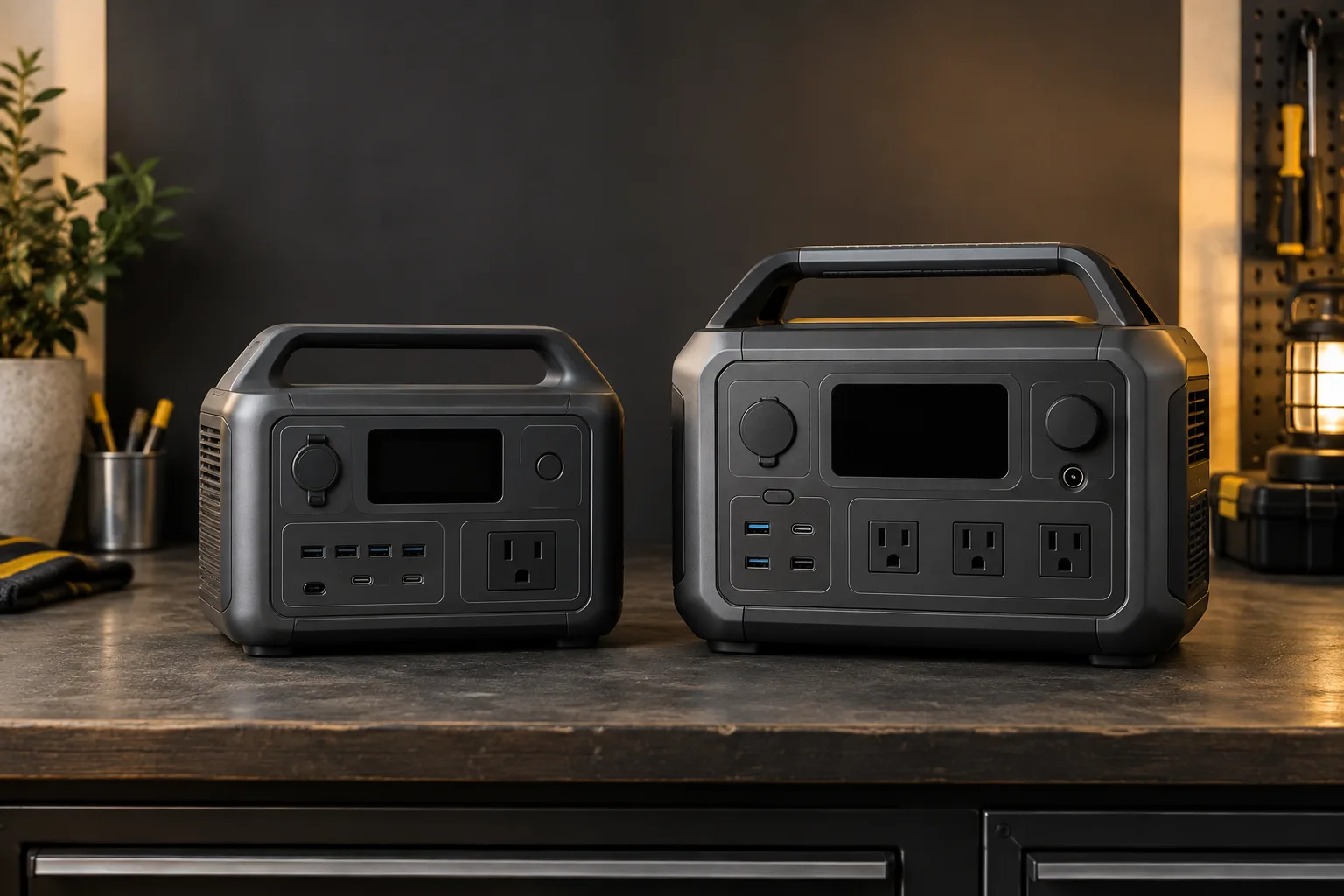
Why there is no honest one-line winner
Brand-level comparisons flatten different products into a slogan. A compact station, a mid-size camping model and a larger home-backup system can sit under the same brand name while solving different problems. Product names and specifications change, so this page gives you a repeatable comparison method rather than pretending to have performed a current lab test.
Model-to-model comparison matrix
| Compare this field | EcoFlow product sheet | Bluetti product sheet | Why it matters |
|---|---|---|---|
| Continuous AC output | Record the model’s continuous W. | Record the model’s continuous W. | Determines sustained load headroom. |
| Peak / surge output | Record peak W and duration. | Record peak W and duration. | Important for pumps, refrigerators and tools. |
| Battery capacity | Nominal and usable Wh if listed. | Nominal and usable Wh if listed. | Controls runtime; definitions must match. |
| Charging inputs | Wall, solar, car and limits. | Wall, solar, car and limits. | Determines how quickly the battery can refill. |
| Ports | AC, USB-C PD, USB-A, DC and RV options. | AC, USB-C PD, USB-A, DC and RV options. | Compatibility matters as much as total watts. |
| Expansion / transfer | Documented batteries, UPS or transfer options. | Documented batteries, UPS or transfer options. | Affects scale and installation path. |
| Support terms | Warranty, manuals and service path. | Warranty, manuals and service path. | A backup system is a long-term equipment decision. |
A five-minute comparison workflow
- 01Write the load list and target duration before opening either brand’s catalog.
- 02Run the loads through the wattage calculator and note the continuous and peak targets.
- 03Copy the same fields from both exact model sheets into the matrix above. Do not compare a product’s peak output with another product’s continuous output.
- 04Use the runtime calculator with each battery’s published capacity and the same efficiency/reserve assumptions.
- 05Check the manual for pass-through, UPS-like behavior, temperature, moisture, cable and transfer limitations before treating a feature as a requirement met.
Where buyers commonly go wrong
- Choosing the largest battery while missing a needed 240V, 30A, USB-C PD or DC output.
- Treating a fast recharge claim as a guarantee for every outlet, temperature and battery state.
- Assuming an app feature replaces a physical output, manual or support commitment.
- Comparing nominal battery Wh across pages that define usable energy differently.
- Assuming a product line’s brand reputation proves that a particular model fits a refrigerator, CPAP, RV or pump.
FAQ
Is EcoFlow better than Bluetti?
There is no honest brand-wide answer. Compare the exact models against your load, runtime, ports, recharge and support requirements.
Do these brands offer solar generators?
Both brands use consumer language around battery power stations and solar charging. Verify the actual system components and solar-input limits for the model.
Where should I check prices?
Use the current manufacturer or authorized merchant page after you have identified the right specifications. This page intentionally does not invent or freeze prices.
Planning guide · United States context · Updated September 20, 2026. Product lines, firmware, port standards and manufacturer limits change; verify the current manual before buying or connecting a load.