
Quick answer
Yes, most portable power stations can run an electric blanket. An extension-service reference lists typical electric blankets at about 60 W (single) to 100 W (double) on the nameplate, and some larger or dual-control models list more. That is well inside the continuous AC output of almost any station sold for camping or home backup. The real question is how many hours you get, and that depends on usable battery watt-hours and the blanket's average draw on your heat setting, not on the label maximum.
A quick rule: hours ≈ (station Wh × 0.765) ÷ (blanket average W + about 15 W station overhead). With that rule, a 1,000 Wh station runs a blanket averaging 60 W for about 10 hours. That's a full night for many people, but it's an estimate to check with your own blanket, not a promise.
In this guide
- How many watts does an electric blanket use?
- Runtime table: how long will a power station run an electric blanket?
- The overhead most runtime estimates miss
- AC blanket or 12V heated blanket?
- What size power station do you need?
- Setup and safety checklist
- FAQ
Fits this load: Bluetti AC180. 1,152 Wh battery and 1,800 W pure sine wave AC output, far above a typical blanket’s draw. Use the runtime rule above with your blanket’s average watts.
How many watts does an electric blanket use?
Start with the label on the blanket's plug, controller or care tag. US blankets usually show 120 V plus either watts or amps. If only amps are listed, multiply by 120 to get watts (Virginia Cooperative Extension uses the same volts × amps method).
| Blanket type | What the label typically shows | What to do with it |
|---|---|---|
| Single/twin electric blanket | About 60 W (extension-service reference figure) | Use as the maximum draw |
| Double/full electric blanket | About 100 W (extension-service reference figure) | Use as the maximum draw |
| Queen/king, dual-control | Often higher; both sides are on the same plug | Add both sides if the label lists them separately |
| Heated throw | Varies by model | Read the label, don't guess |
| 12V vehicle heated blanket | Volts and amps (for example 12 V × amps) | Runs from the station's 12V car outlet |
Label watts are the maximum. Most blankets have a thermostat or controller that cycles the heating wire on and off. On a low or medium setting the average draw over an hour is usually lower than the label number. The only way to know your average is to measure it. A plug-in watt meter between the blanket and the station shows watt-hours used over a few hours, if the blanket's manual allows it.
Runtime table: how long will a power station run an electric blanket?
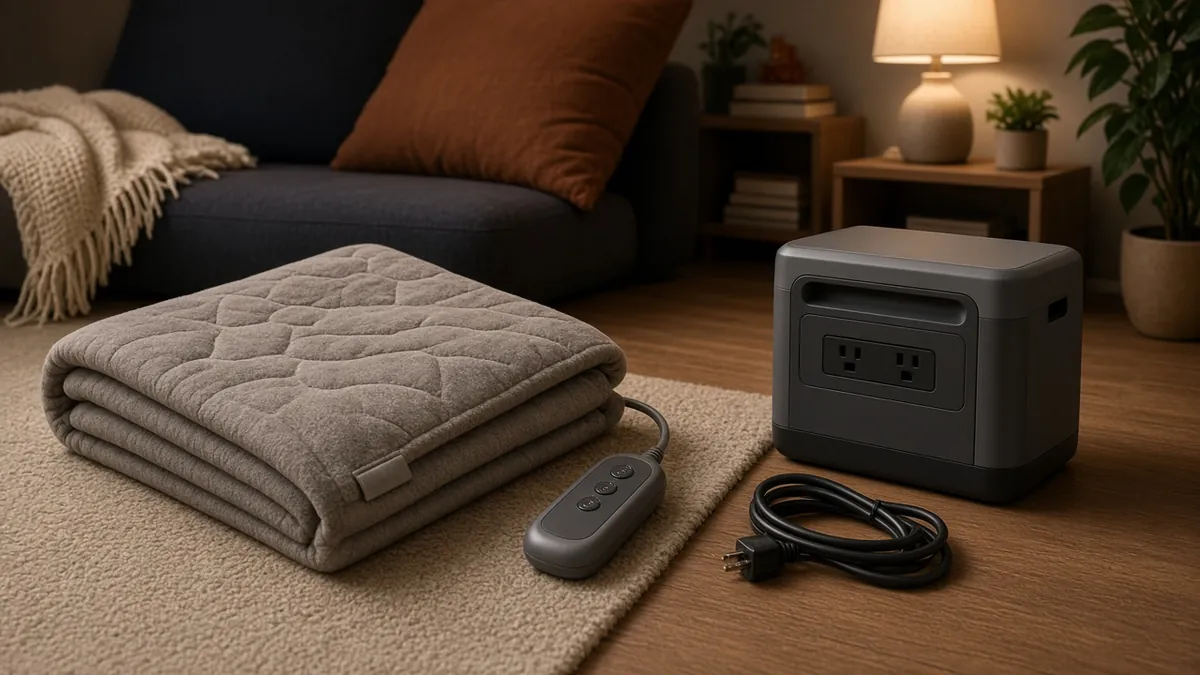
The table uses the same planning assumptions as our runtime calculator: 85% AC efficiency, a 10% battery reserve, and an extra 15 W for the station's own inverter and electronics (see the next section).
| Station capacity | 40 W average | 60 W average | 100 W average | 150 W average |
|---|---|---|---|---|
| 300 Wh | ~4.2 h | ~3.1 h | ~2.0 h | ~1.4 h |
| 500 Wh | ~7.0 h | ~5.1 h | ~3.3 h | ~2.3 h |
| 1,000 Wh | ~13.9 h | ~10.2 h | ~6.7 h | ~4.6 h |
| 2,000 Wh | ~27.8 h | ~20.4 h | ~13.3 h | ~9.3 h |
How to read it: if your double blanket is labeled 100 W but you sleep on a medium setting, your real average might sit somewhere in the 40–60 W columns. If you leave it on high all night, plan on the 100 W column. These are calculated estimates, not test results. Cold batteries, older batteries and other devices plugged in at the same time all shorten them.
Worked example (1,000 Wh station, 60 W average):
- Usable energy: 1,000 Wh × 0.85 efficiency × 0.90 reserve = 765 Wh
- Total load: 60 W blanket + 15 W overhead = 75 W
- Runtime: 765 ÷ 75 ≈ 10.2 hours
The overhead most runtime estimates miss
A power station uses some power just to keep its inverter, screen and wireless radios running. With a big load like a microwave, that overhead barely matters. With a small, steady load like an electric blanket, it matters a lot.
- Bluetti's own runtime formula for the AC180 includes about 15 W of self-consumption alongside a 90% depth of discharge and 85% inverter efficiency.
- Jackery's spec sheet for the Explorer 1000 v2 lists 18 W standby power consumption.
On a 60 W blanket, 15 W of overhead is a 25% bigger load. Ignore it and the 1,000 Wh example above jumps from about 10 hours to about 13. That's why "my station died before morning" is a common complaint. For overnight use, assume some overhead unless your station's manual gives a lower figure, and turn off Wi-Fi/Bluetooth or the screen if the manual says that reduces standby draw.
Watch the low-load auto-off. Many stations have an energy-saving mode that shuts the AC outlet off when the load is small or stops for a while. A blanket that cycles on and off can look "idle" to the station. If your blanket goes cold at 2 a.m. with charge still left, check the AC timeout or energy-saving setting. Jackery, for example, documents that the Explorer 1000 v2's Energy Saving Mode is on by default and can shut outputs off under low loads; its timeout can be adjusted in the Jackery app.
AC blanket or 12V heated blanket?
Plugging a household blanket into an AC outlet means the station converts DC battery power to 120 V AC, and that conversion loses energy. A 12V heated blanket made for cars plugs into the station's 12V car outlet instead. It skips the inverter and usually runs longer on the same battery.
| Household AC blanket | 12V vehicle heated blanket | |
|---|---|---|
| Plugs into | Station's 120 V AC outlet | Station's 12V car outlet |
| Inverter losses | Yes (assume about 15% in planning) | Smaller DC conversion losses |
| Station overhead | Inverter must stay on | Inverter can stay off on many models |
| What to check | Continuous AC watts | The 12V outlet's amp limit (e.g. 12 V/10 A on the Jackery Explorer 1000 v2 and Bluetti AC180) |
| Typical downside | Shorter runtime | Smaller blankets, fewer heat settings, auto-shutoff timers |
Either way, follow the blanket maker's instructions. A 12V blanket should only go in a 12V socket whose current limit is above the blanket's amp rating.
What size power station do you need for an electric blanket?
Size the station for energy (Wh) first. Output (W) is rarely the problem with a blanket.
- Output: any station with a pure sine wave AC output comfortably above your blanket's label watts (plus anything else plugged in) will power it. Most current stations are pure sine wave. That's the safest match for electronic blanket controllers.
-
Energy: pick the hours you need, then work backwards: Wh needed ≈ hours × (average W + 15) ÷ 0.765. - 8 hours at 60 W average → about 785 Wh → look at 1,000 Wh class stations - 8 hours at 100 W average → about 1,200 Wh → look at 1,200–1,500 Wh or larger - Two blankets, or a blanket plus a CPAP → add the loads and size up
-
Recharge: for multi-night camping, plan how you'll refill the battery. See how to charge a power station with solar panels and our off-grid camping planner.
Example 1 kWh-class stations (spec sheet figures, checked October 2026):
| Model (example only) | Battery | Continuous AC output | Est. hours at 60 W avg* |
|---|---|---|---|
| Jackery Explorer 1000 v2 | 1,070 Wh LiFePO4 | 1,500 W | ~10.9 h |
| EcoFlow DELTA 3 Plus | 1,024 Wh LiFePO4 | 1,800 W | ~10.4 h |
| Bluetti AC180 | 1,152 Wh LiFePO4 | 1,800 W | ~11.8 h |
*Same planning assumptions as the runtime table. These are not our test results. Spec sheets change, so check the current product page. For brand differences, see EcoFlow vs Bluetti vs Jackery.
Setup and safety checklist
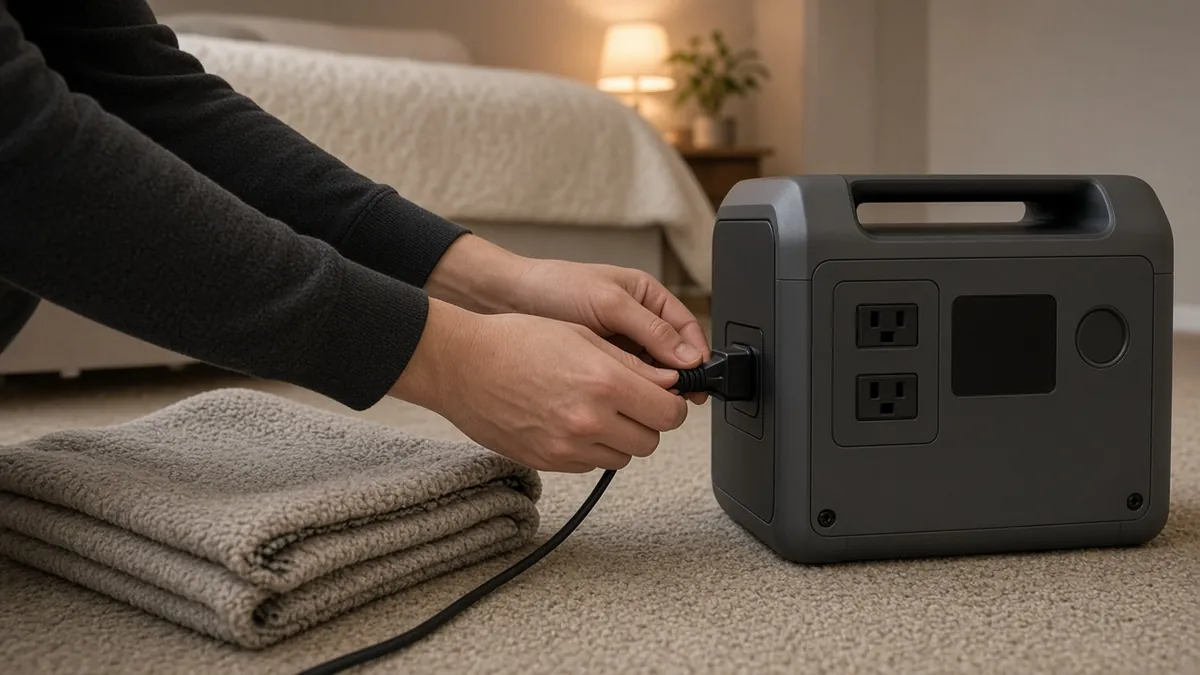
- Inspect the blanket and cord first. The U.S. Consumer Product Safety Commission's home electrical safety checklist warns against using electric blankets with damaged, frayed, cracked or charred cords, and against folding or tucking them in a way that traps heat.
- Keep the station off the bed. Put it on the floor or a table where it's dry, ventilated and not covered by bedding. Don't block its fans or vents.
- Plug the blanket straight in. Use the station's outlet directly. If you need an extension cord, use a properly rated one and only if the blanket manual allows it.
- Charge before bed and check the reserve. Start from a full charge. If you also need the station for a phone, CPAP or lights, keep enough reserve for those.
- Mind the temperature. Batteries deliver less in the cold, and many stations limit charging below freezing. If you're in a cold tent or vehicle, keep the station inside the warmest part of the space, within the manual's operating range.
- Check for recalls on older blankets before relying on one off-grid.
FAQ
Can a portable power station run an electric blanket all night?
Will a 300W power station run an electric blanket?
How long will a 500Wh power station run an electric blanket?
How many watts does an electric blanket use?
Is it better to use a 12V heated blanket with a power station?
Is it safe to run an electric blanket from a power station?
Related guides
- Portable power station runtime calculator: plug in your own Wh and watts
- Portable power station wattage calculator: add up everything you'll run at once
- Portable power station for CPAP: another overnight load
- Portable power station 1000W guide
- Portable power station battery life: cycle life and storage
Sources
- Virginia Cooperative Extension, Estimating Appliance and Home Electronic Energy Use (BSE-301NP): watts = volts × amps; typical electric blanket nameplate 60/100 W (single/double). https://www.pubs.ext.vt.edu/content/dam/pubs_ext_vt_edu/2901/2901-9014/BSE-301.pdf
- U.S. CPSC, Home Electrical Safety Checklist (electric blanket and cord inspection). https://www.cpsc.gov/s3fs-public/513.pdf
- Bluetti AC180 product page and FAQ (runtime formula: 90% DoD, 85% efficiency, ~15 W self-consumption; 12V/10A car outlet; 1,152 Wh; 1,800 W). https://www.bluettipower.com/products/ac180
- Jackery Explorer 1000 v2 basic information (1,070 Wh; 1,500 W; 12V/10A; 18 W standby; Energy Saving Mode on by default; settings adjustable in the app). https://faq.jackery.com/hc/en-us/articles/52303615153051-Explorer-1000-V2-Basic-Information
- EcoFlow DELTA 3 Plus product page (1,024 Wh LFP; 1,800 W). https://us.ecoflow.com/products/delta-3-plus-portable-power-station