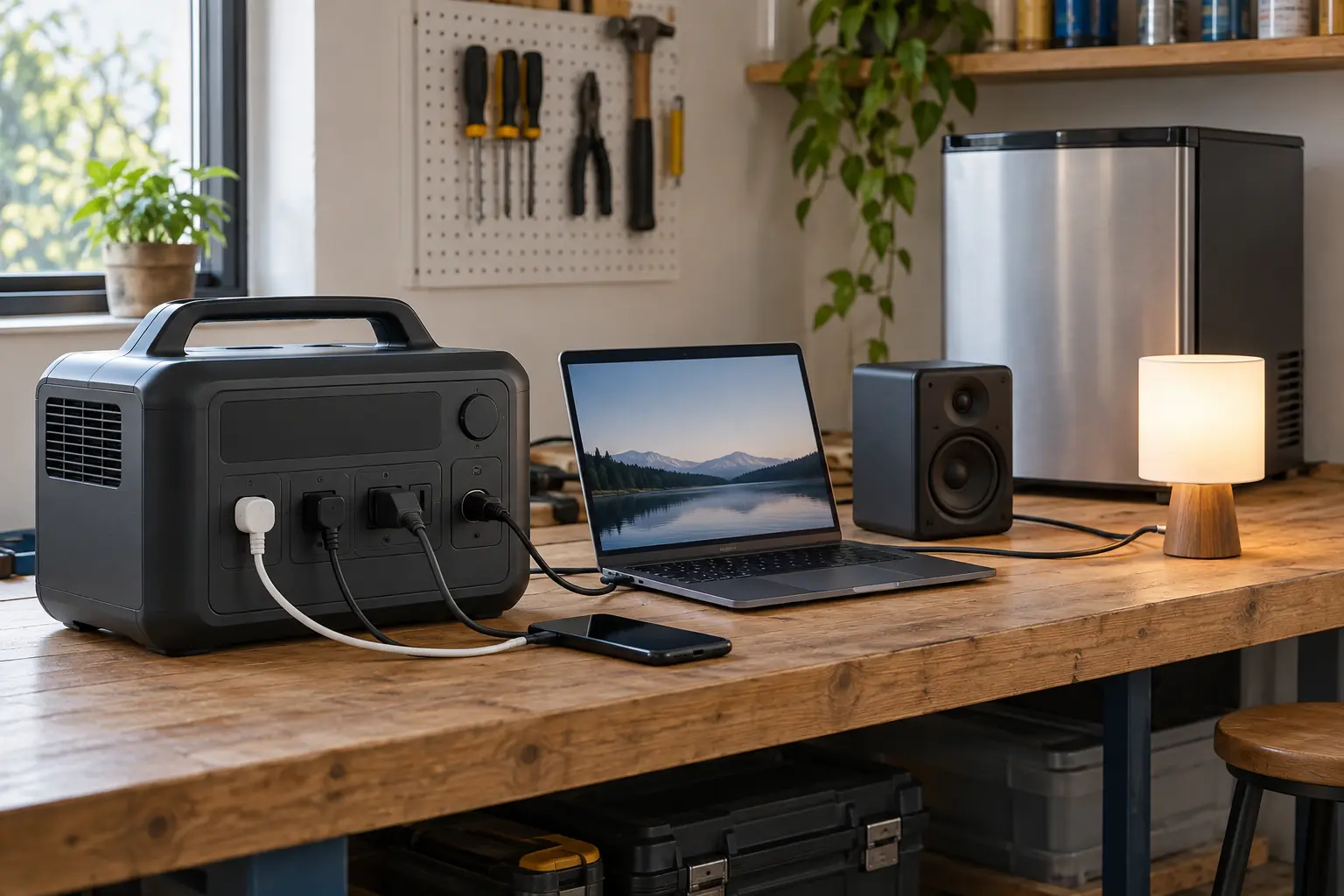
Quick answer
Pure sine wave describes the shape of the AC output from the inverter. A smooth waveform is generally the safer default for equipment with motors, compressors, timing circuits, audio components or sensitive power supplies. It does not make an undersized station suitable, and it does not guarantee that every device will operate normally.
Example station: Bluetti AC180. A pure sine wave inverter with 1,800 W AC output and a 1,152 Wh battery.
Why waveform can affect a load
AC-powered equipment expects power within a particular voltage and frequency range. A motor or compressor can react differently to a rougher approximation of a sine wave: it may hum, run hotter, draw more current or fail to start. Some electronic power supplies tolerate it; others may introduce noise or instability.
Waveform
Describes the shape of the inverter’s AC output. It is a compatibility characteristic, not a battery-size rating.
Continuous W
Shows the sustained output ceiling. A pure waveform cannot compensate for too little continuous power.
Peak W
Shows short startup headroom. Refrigerators, pumps and other motors may need it even when their running watts are modest.
Loads where pure sine wave deserves attention
| Load type | Why it deserves a check | What to verify |
|---|---|---|
| Refrigerator or freezer | The compressor starts with a surge and may be sensitive to the inverter output. | Pure sine wave, peak watts, startup behavior and expected runtime. |
| Sump pump or other motor | Starting current can be much higher than the running label. | Waveform, continuous W, peak W and a supervised startup test. |
| CPAP machine | The device and humidifier can have different power paths and requirements. | Manufacturer input, compatible AC/DC path, wattage and runtime; avoid medical claims. |
| Audio equipment | Electrical noise or an incompatible supply can become audible or cause instability. | Pure sine specification, grounding guidance and the equipment manual. |
| Laptop or charger | Modern chargers often regulate input, but compatibility still depends on the charger and outlet. | AC voltage/frequency, charger rating and whether USB-C PD is the better path. |
| Heating element | Waveform is usually less central than total watts, but the load can drain the battery quickly. | Continuous output, outlet limit, battery Wh and ventilation. |
Pure sine wave versus “modified” output
Product pages may describe non-pure output with terms such as modified sine wave or stepped approximation. These labels are not a complete safety or compatibility verdict, because the actual device, load and inverter design matter. For a new purchase, pure sine wave is usually the simpler baseline when you plan to run motors, compressors, audio equipment or electronics with an unknown power supply.
| Question | Why it matters |
|---|---|
| Does the AC outlet specify pure sine wave? | The phrase should apply to the output you intend to use, not only to a product family or marketing headline. |
| Are voltage and frequency correct? | Waveform quality cannot fix a mismatch in voltage, frequency or plug/output configuration. |
| Is there enough surge headroom? | A refrigerator or pump can fail to start even with pure sine output if the peak rating is too low. |
| Could a direct DC or USB-C path work? | Avoiding an AC conversion can improve efficiency when the device and cable are explicitly compatible. |
A practical compatibility workflow
- 01Read the device label and manual. Record voltage, frequency, running watts, starting watts or VA, connector and any manufacturer warning about inverters.
- 02Use the wattage calculator to total simultaneous running loads and keep motor startup loads visible.
- 03Confirm that the power station specifies pure sine wave AC output at the voltage and frequency your equipment expects.
- 04Use the runtime calculator with battery Wh, a realistic average load, efficiency and reserve.
- 05Test one load at a time in a ventilated, dry location. Watch for alarms, unusual heat, humming, unstable charging or an overload shutdown.
- 06Do not improvise a hardwired connection, defeat a protective device or rely on a waveform label instead of the exact manual.
Waveform is only one part of sizing
Start with the load, then check the four constraints together. Pure sine wave answers the shape of the AC output; it does not answer the other questions.
- Output: can the station supply the continuous watts without running at the edge of its rating?
- Surge: can it start the compressor, pump or motor, and for how long?
- Energy: do the battery watt-hours cover the target duration after losses and reserve?
- Connection: is the AC, USB-C or DC path compatible with the device’s voltage, current and cable?
- Environment: can the station stay cool, dry and ventilated while the load operates?
FAQ
Do all portable power stations have pure sine wave output?
Is pure sine wave necessary for a laptop?
Will pure sine wave make a refrigerator run longer?
Is pure sine wave enough for a sump pump?
Planning guide · United States context · Updated October 24, 2026. Product lines, firmware, port standards and manufacturer limits change; verify the current manual before buying or connecting a load.