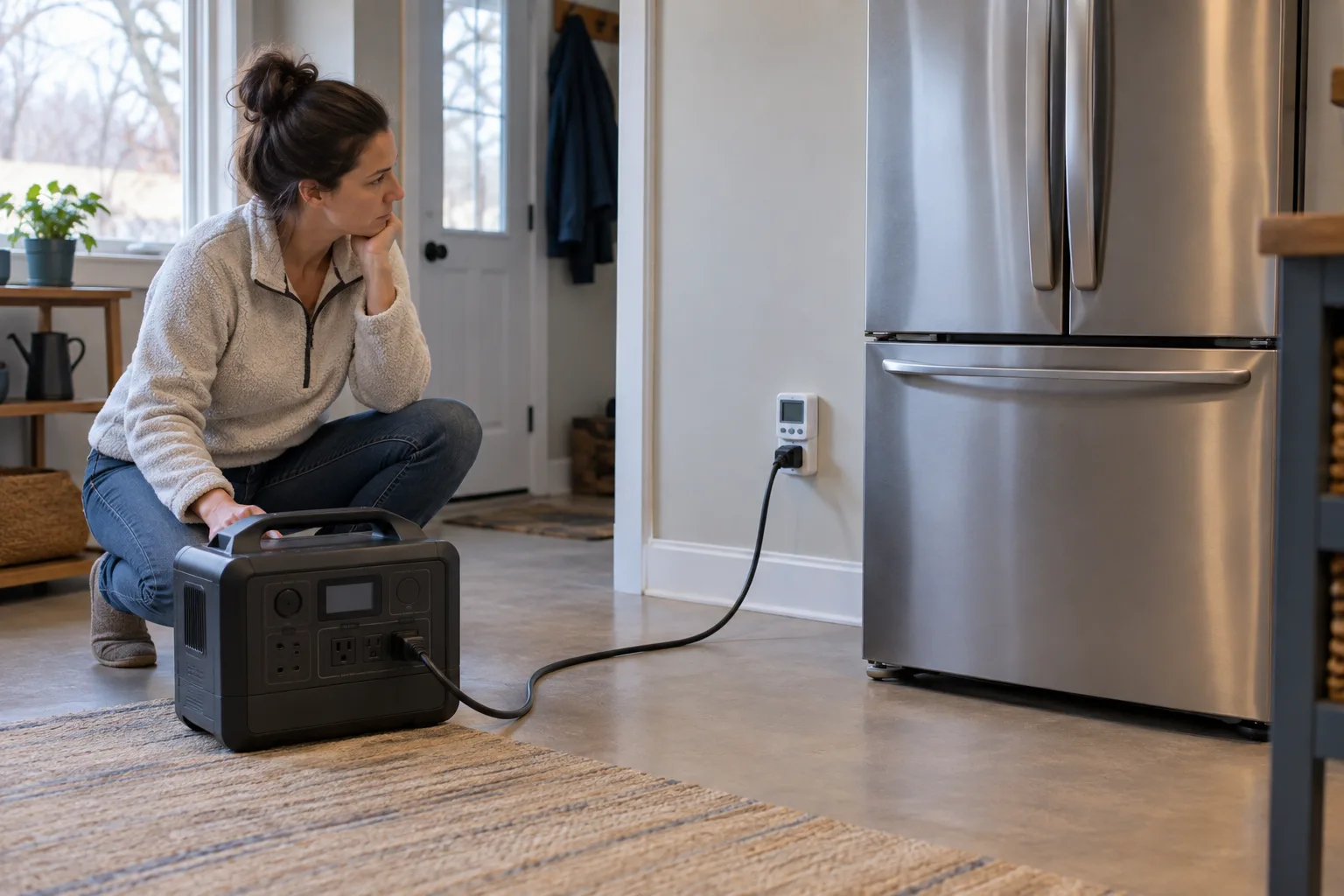
Can a portable power station run a refrigerator?
Often, a compatible station can run a refrigerator for a period of time, but a headline wattage comparison is not enough. The station must tolerate the compressor’s startup event, supply the correct AC output and have enough usable battery energy for the target window. A refrigerator that runs intermittently may use less energy over an hour than its running wattage suggests, but the exact duty cycle varies with temperature, door openings, ice-making and age.
Sizing for a compact or dorm fridge? See how many watts a mini fridge uses for running, average and startup watts.
Fits this load: Bluetti Elite 100 V2. 1,024 Wh battery, the same size as the estimate on this page, and 1,800 W AC output. Check your fridge’s startup watts against the 1,800 W rating before you rely on it.
Three numbers to collect
Running watts
The draw while the compressor and controls are operating. Read the nameplate or observe it with a meter.
Startup / surge
The short event when the compressor starts. The station’s peak capability must cover it according to the manufacturer’s limits.
Average energy
The watt-hours used across the time window. Cycling means this is usually lower than running watts × every minute.
A transparent runtime estimate
For a first estimate:
Use an average that reflects a complete cycle, not only the compressor’s on-state. If you only have running watts, model a range and label it as uncertain. For example, 783 Wh of usable energy divided by an illustrative 70W average load is about 11.2 hours; that is a planning example, not a refrigerator claim.
| Input | Better source | Why it changes the answer |
|---|---|---|
| Running watts | Appliance label or meter | Shows the sustained inverter load. |
| Startup event | Power-quality meter or manufacturer data | Can trip an undersized inverter even when running watts look small. |
| Duty cycle | Observation over several hours | Compressor on-time changes with conditions and door openings. |
| Other kitchen loads | Circuit map / appliance list | The station may be asked to power more than the refrigerator. |
Connection and operating cautions
- Use a correctly rated extension cord only when the manufacturer’s instructions allow it; keep the run short and inspect it for damage.
- Do not connect a power station to a household receptacle to energize a panel. Backfeeding is dangerous and not a substitute for a transfer switch.
- Keep the station dry, ventilated and away from the refrigerator’s heat exhaust. Do not place it where condensation or spills can reach the vents.
- If the station has an economy or low-load shutdown mode, verify that compressor cycling does not confuse the system.
- If food safety depends on the backup, treat runtime as a range and have a second plan for extended outages.
FAQ
How many watts does a refrigerator use?
How long will a 1,000W power station run a refrigerator?
Can I run the refrigerator and other appliances?
Planning guide · United States context · Updated October 24, 2026. Product lines, firmware, port standards and manufacturer limits change; verify the current manual before buying or connecting a load.