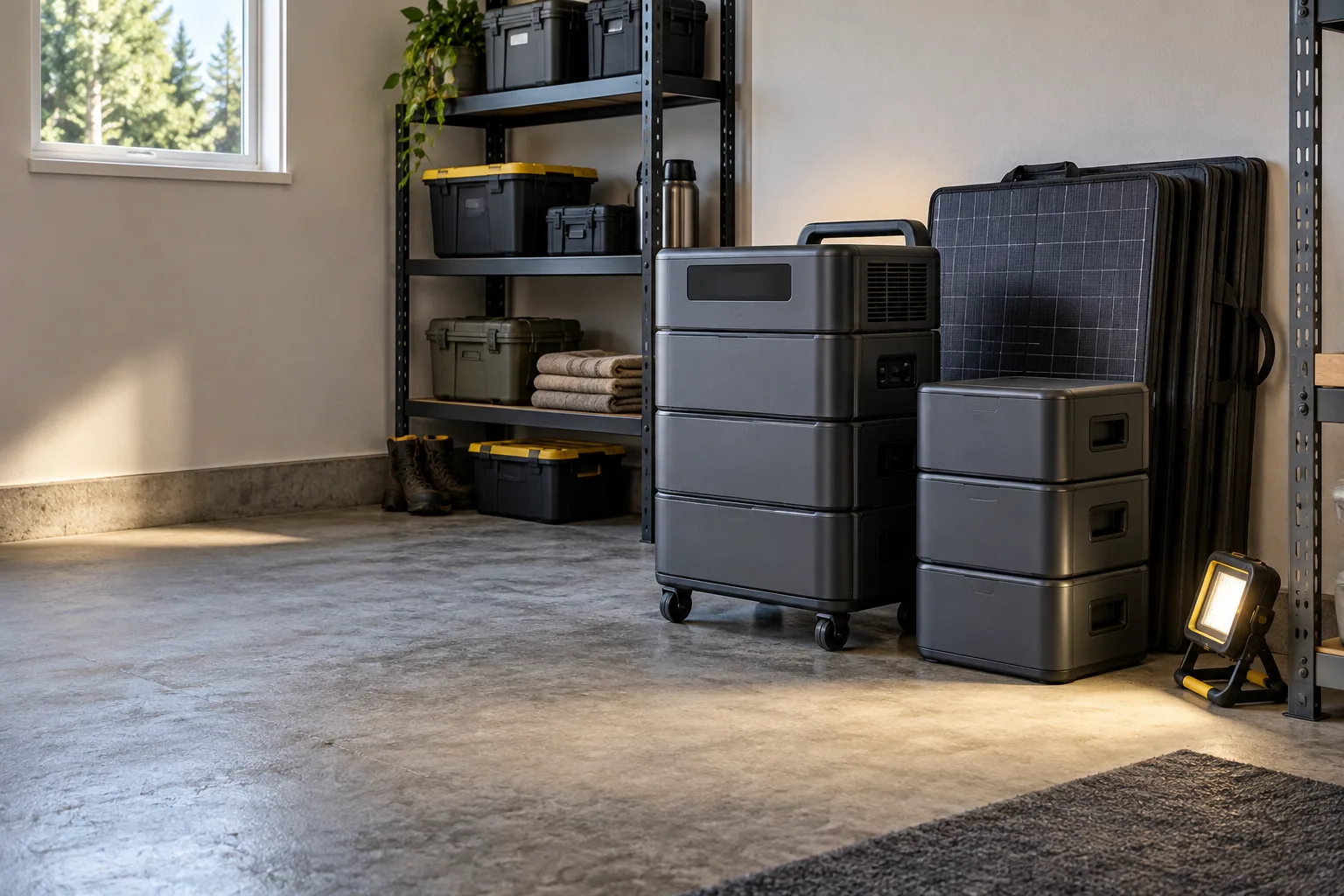
First, separate watts from watt-hours
Watts measure power at a moment. Watt-hours measure stored energy over time. A system can have a high inverter output and a relatively small battery, or a large battery with a lower output ceiling. Ask the seller or manufacturer to identify each number separately.
| Question | Why it matters |
|---|---|
| Is 10,000W continuous or peak? | Continuous output is the meaningful ceiling for sustained loads; peak only covers short events. |
| What is the battery capacity in Wh? | That determines the starting point for runtime and recharge planning. |
| Is it one unit or a split / expandable system? | Parallel batteries and inverters may change wiring, output, transfer and installation requirements. |
| What voltage and phase are available? | 120V, 240V and split-phase use cases are not interchangeable. |
A 10,000W system is not automatically whole-home backup
Home backup depends on the circuits, transfer equipment, neutral and ground arrangements, inlet, local code and the station’s approved installation method. A portable unit plugged into a wall outlet must not be used to backfeed a panel. If you want selected circuits or a 240V load powered during an outage, involve a qualified electrician and follow the manufacturer’s transfer equipment instructions.
How to compare large solar generators
| Specification | What to verify | Common mistake |
|---|---|---|
| Inverter output | Continuous, surge, duration and waveform. | Treating a peak badge as a sustained rating. |
| Battery architecture | Nominal/usable Wh, chemistry, expansion and warranty terms. | Comparing nominal Wh on one model with usable Wh on another. |
| Solar input | Maximum input watts, voltage range, current and connector. | Assuming a larger panel always charges faster or safely. |
| AC output | Outlet count, voltage, breaker/GFCI and 30A/50A options. | Assuming every outlet can deliver the headline output. |
| Recharge strategy | Wall, vehicle, generator or solar refill time under stated conditions. | Planning for runtime without a way to restore the battery. |
The loads that expose weak assumptions
- Heating elements can consume a large share of a battery quickly even when the inverter can technically run them.
- Motors and compressors may require a short startup surge that is missing from a simple running-watt calculation.
- 240V appliances may need a split-phase or dual-inverter arrangement; a 120V outlet is not a substitute.
- A sump pump, refrigerator or well pump may cycle unpredictably, so runtime is better modeled as an average plus startup margin.
- A home circuit can include hidden loads. List the exact breakers and use an electrician for any transfer or hardwired connection.
FAQ
Does a 10,000W solar generator have a 10,000 Wh battery?
Can it run a whole house?
Is “solar generator” a standardized technical category?
Planning guide · United States context · Updated September 20, 2026. Product lines, firmware, port standards and manufacturer limits change; verify the current manual before buying or connecting a load.