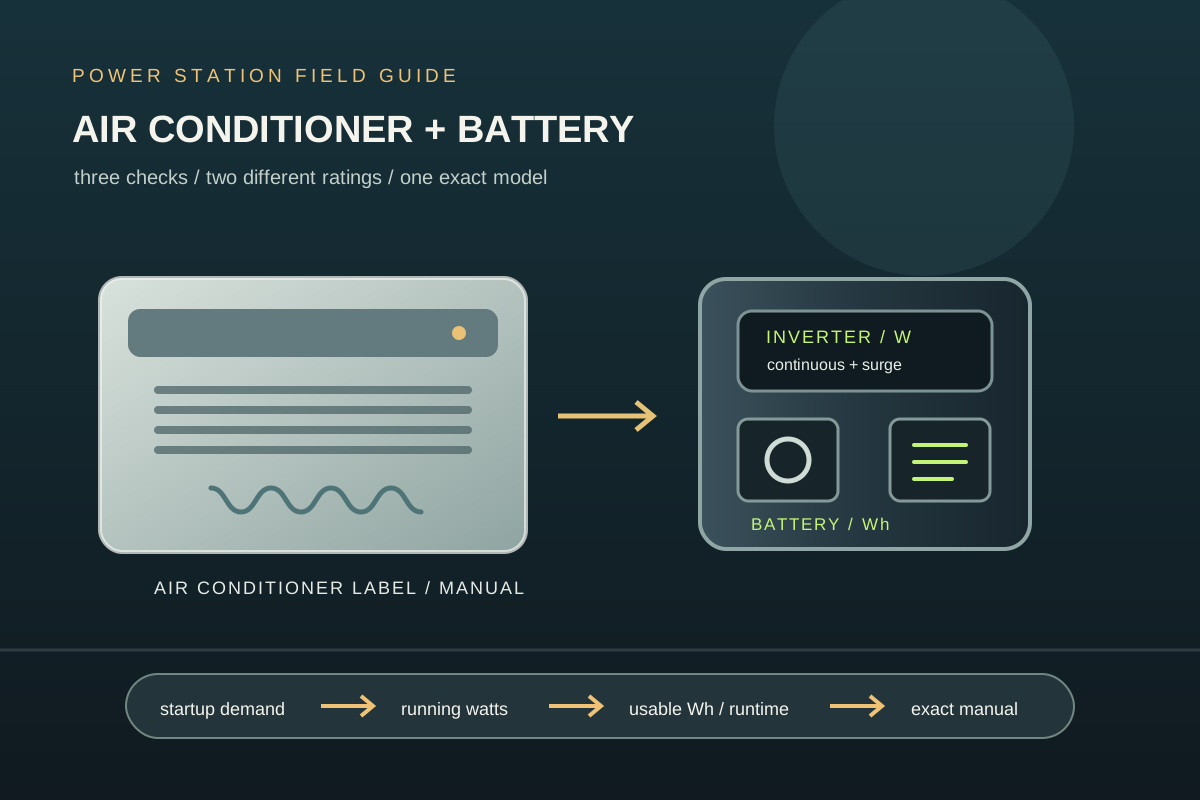
Quick answer
A portable power station may run some plug-in air conditioners when its AC voltage, continuous output and startup capability match the exact unit, and its usable battery energy supports the time you need. A wattage label or battery size alone cannot establish fit. Window, portable, inverter-driven and central systems have different electrical requirements.
Fits this load: Bluetti Elite 200 V2. 2,600 W continuous AC output and a 2,073.6 Wh battery. Runtime on an air conditioner is short: Bluetti’s own table lists an 8,100 BTU unit at about 0.7 hours. Check your AC’s startup watts too.
Read the air conditioner’s label and manual
Start with the exact model number and the manufacturer’s electrical specifications. Look for rated input watts or amps, voltage, frequency and any compressor starting or locked-rotor data (often shown as LRA). If the manual documents an approved soft-start or startup method, record it; do not infer compatibility from BTU capacity alone.
Do not treat minimum circuit ampacity (MCA), breaker size or a plug shape as the air conditioner’s actual running wattage. If the manufacturer does not provide an input figure, ask for it or use a properly rated meter and a safe, compatible setup. Do not open the unit or measure exposed wiring.
Portable power stations vary by outlet voltage and capacity. A 120V receptacle cannot power a 240V unit just because an adapter fits; never improvise a plug or bridge outlets. Confirm the air conditioner and station manuals specify compatible voltage and frequency.
Check continuous output and compressor startup
Compare the air conditioner’s running requirement with the station’s continuous AC output and any individual outlet limit. Then check the startup event separately. Compressor motors can briefly demand more when they start, but there is no universal surge multiplier that safely applies to every unit; inverter compressors, soft-start equipment and conventional compressors can behave differently.
Use the air conditioner manufacturer’s starting data when available. Compare it with the portable station’s peak rating and the documented duration of that rating. If the station only gives a vague peak number without duration or model-specific compatibility, do not treat that as a confirmed start. EcoFlow’s air-conditioner planning guide also separates running demand from compressor startup and stresses checking both against the station output; any example in a manufacturer article is not a substitute for your own unit’s specifications.
For multiple devices, list what will run at the same time. Use the wattage calculator to keep continuous and startup values separate, then verify the station’s combined outlet limits.
Estimate runtime from usable watt-hours
A compatible inverter does not guarantee a useful cooling window. A simple planning formula is:
Use the station maker’s usable battery capacity where available. If the manual lists nominal capacity only, include a reasonable allowance for conversion losses and the reserve you plan to keep. Do not divide battery Wh by the inverter’s maximum output; use the air conditioner’s average draw over the period you care about.
Real draw changes with thermostat settings, outdoor temperature, room heat, insulation, fan mode and compressor cycling. Variable-speed or inverter units may modulate output; a hot room or continuous cooling demand can keep the compressor running longer. Measure a representative operating period if the manufacturer allows it, and treat the result as an estimate rather than a runtime guarantee. Enter the figures in the runtime calculator and adjust for the actual model.
A practical compatibility workflow
- 01Write down the exact air conditioner model.
Record rated input, voltage, frequency and any manufacturer startup data from the nameplate or manual.
- 02Check the station’s actual AC output.
Verify continuous watts, peak watts and peak duration, outlet voltage, outlet-level limits and permitted temperature range.
- 03Confirm the startup path.
Use the AC maker’s starting data or an appropriate, safely obtained measurement. Do not guess from BTUs, plug shape or a generic multiplier.
- 04Estimate the cooling window.
Use usable Wh and representative average watts, then allow for conversion loss, reserve and changing compressor demand.
- 05Test before relying on it.
Follow both manuals, use only the intended plug-in outlet, keep the station dry and ventilated, and supervise a controlled test before an outage or trip.
Portable units and home circuits need different plans
A plug-in window or portable air conditioner is simpler to evaluate because the appliance uses a cord and receptacle. A central system or hardwired mini-split may require 240V service, a large startup capability or a fixed electrical connection. Do not connect a station to a household circuit through an improvised cord or outlet; never backfeed a panel. A fixed backup setup requires manufacturer-approved transfer equipment and a qualified electrician.
For another motor appliance, see the refrigerator guide and sump pump guide; each has different duty cycles and startup behavior.
FAQ
Can a portable power station run an air conditioner?
How many watts does a portable power station need for an AC?
How long can a power station run an air conditioner?
Can a portable power station run central air conditioning?
Does a higher BTU rating tell me the battery runtime?
Manufacturer reference
Source checked October 1, 2026: EcoFlow’s air-conditioner battery-backup guide explains why both running demand and compressor startup should be checked against inverter output. It is general manufacturer guidance; the nameplate and current manual for your air conditioner and station take precedence.
Planning guide · United States context · Updated October 24, 2026. Product lines, firmware, port standards and manufacturer limits change; verify the current manual before buying or connecting a load.