Quick answer
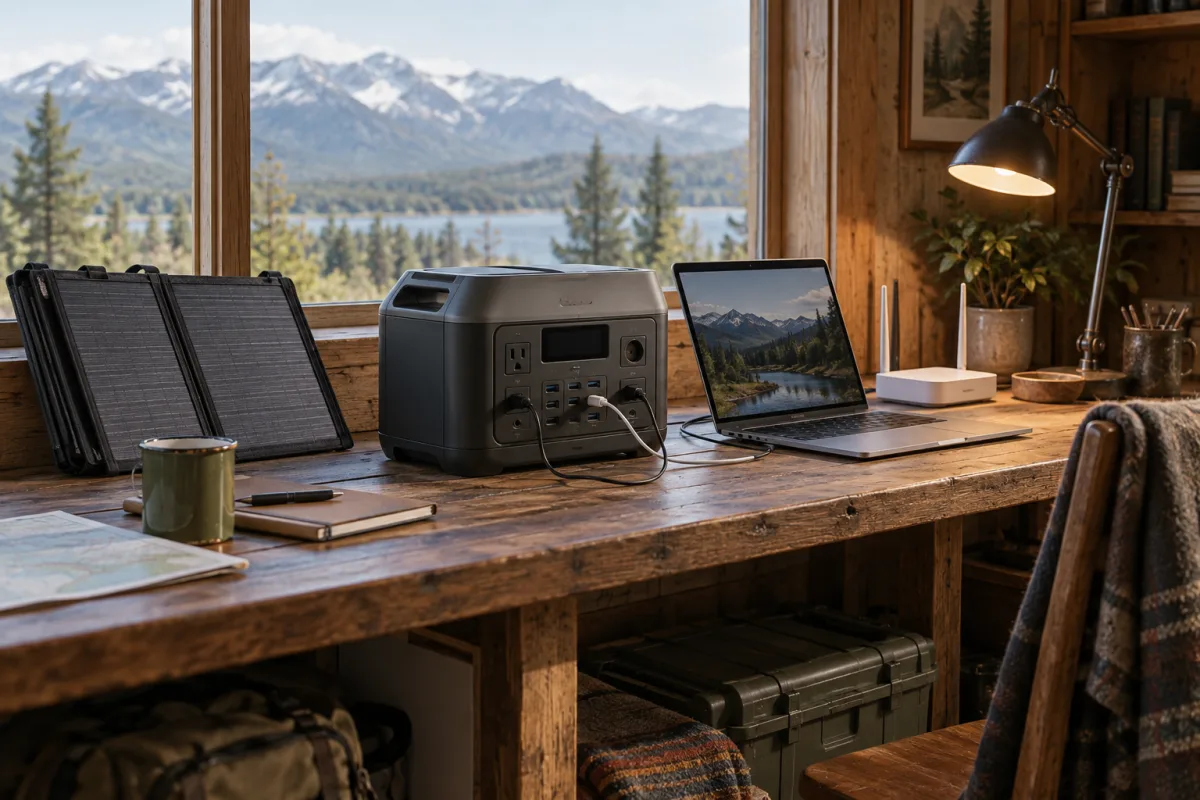
A 2000W portable power station can run most single 120 V household loads at once: a refrigerator, a sump pump, a microwave, a 1,500 W space heater, a CPAP or a circular saw, but not all of them together, and not 240 V equipment. The 2000W figure is the inverter's output, not the battery. For runtime, use the battery's watt-hours: hours ≈ Wh × ~0.85 ÷ load watts. A 2,000 Wh battery gives roughly 1.1 hours at 1,500 W, 3.4 hours at 500 W or about a day for a cycling refrigerator. Motor loads (fridges, pumps, compressors, saws) also need a starting-watt check, because they briefly pull two to three times their running watts.
If you want a station that's ready to buy, these two 2 kWh Bluetti models cover the two most common jobs:
Quick picks: two 2000W-class power stations
Home backup / highest output: Bluetti Elite 200 V2. 2,073.6 Wh battery and 2,600 W continuous AC output, so a 2,000 W load runs with margin. Its 3,900 W Power Lifting mode is for resistive loads only (kettles, heaters, hair dryers), so size motor loads against the 2,600 W figure.
RV pick: Bluetti AC200L (discontinued). Bluetti's US store now lists the AC200L and all of its bundles as discontinued (checked November 1, 2026), so check availability before you plan around it. 2,048 Wh and 2,400 W AC output, including a 120 V/30 A NEMA TT-30 outlet for an RV shore-power cord, plus 1,200 W of solar input on a wide 12–145 V window. It can also grow with Bluetti expansion batteries.
How we chose: both carry about 2 kWh, clear a 2,000 W continuous load, and have complete specs on Bluetti's official US pages (read October 27, 2026). Specs are the manufacturer's, not our test results. Details in How we chose.
What can a 2000W power station run?
The table below uses typical, approximate wattages for common US appliances. Your own device can be higher or lower. Check its nameplate or measure it with a plug-in watt meter before you rely on a number. Runtimes assume a 2,000 Wh battery and about 85% inverter efficiency (1,700 usable Wh), with the load running on its own.
| Appliance (typical) | Running watts (approx.) | Starting watts (approx.) | Fits a 2,000 W inverter? | Est. runtime on 2,000 Wh |
|---|---|---|---|---|
| Full-size refrigerator | 150–200 W while the compressor runs; ~70–100 W averaged over a day | ~600–1,200 W | Yes | ~17–24 h (cycling) |
| Sump pump, 1/2 HP (120 V) | ~1,000 W | ~2,000–2,200 W | Running yes; starting is tight, check surge | ~1.7 h of pump-on time |
| Microwave, 1,000 W cooking power | ~1,200–1,500 W input | — | Yes, alone | ~1.1–1.4 h of cooking |
| Space heater (high / low) | 1,500 W / 750 W | — | Yes | ~1.1 h / ~2.3 h |
| CPAP (no heated humidifier) | ~30–60 W | — | Yes | ~28–57 h |
| Window AC, 5,000–8,000 BTU | ~450–800 W | ~1,300–2,200 W | Usually; check starting watts | ~2–4 h with the compressor on |
| Circular saw, 7¼-inch | ~1,200–1,400 W | ~2,000–2,500 W | Running yes; starting can trip some units | ~1.2–1.4 h of cutting |
| Coffee maker | ~800–1,200 W | — | Yes | ~1.4–2.1 h of brewing |
| Laptop (via AC adapter) | ~50–100 W | — | Yes | ~17–34 h |
| Wi-Fi router + modem | ~15–25 W | — | Yes | ~68–113 h |
| 55-inch LED TV | ~60–120 W | — | Yes | ~14–28 h |
Typical/approximate values from common appliance ratings and generator sizing charts, rounded. They are not measurements of a specific model.
Running watts vs starting watts
- Running (continuous) watts are what a device draws once it's going. Add the running watts of everything that will be on at the same time and keep the total under the station's continuous AC rating, with some headroom.
- Starting (surge) watts are a brief spike, usually under a second or two, when a motor or compressor kicks on. Resistive loads such as heaters, kettles and toasters have no real startup spike. Fridges, sump pumps, window ACs and saws do.
- A station must cover both: the running total and the largest single startup on top of whatever else is running. If two motor loads start together, add both spikes. Our portable power station wattage calculator adds running and starting watts for you.
The runtime formula
The 0.85 covers inverter and conversion losses on AC. Use the average draw: a refrigerator that pulls 150 W while the compressor runs might average 70–100 W over a day, because it cycles. Cold weather, the station's own idle draw and a low-battery cutoff shorten real runtimes, so treat every number on this page as an estimate. For your own load list, use the portable power station runtime calculator.
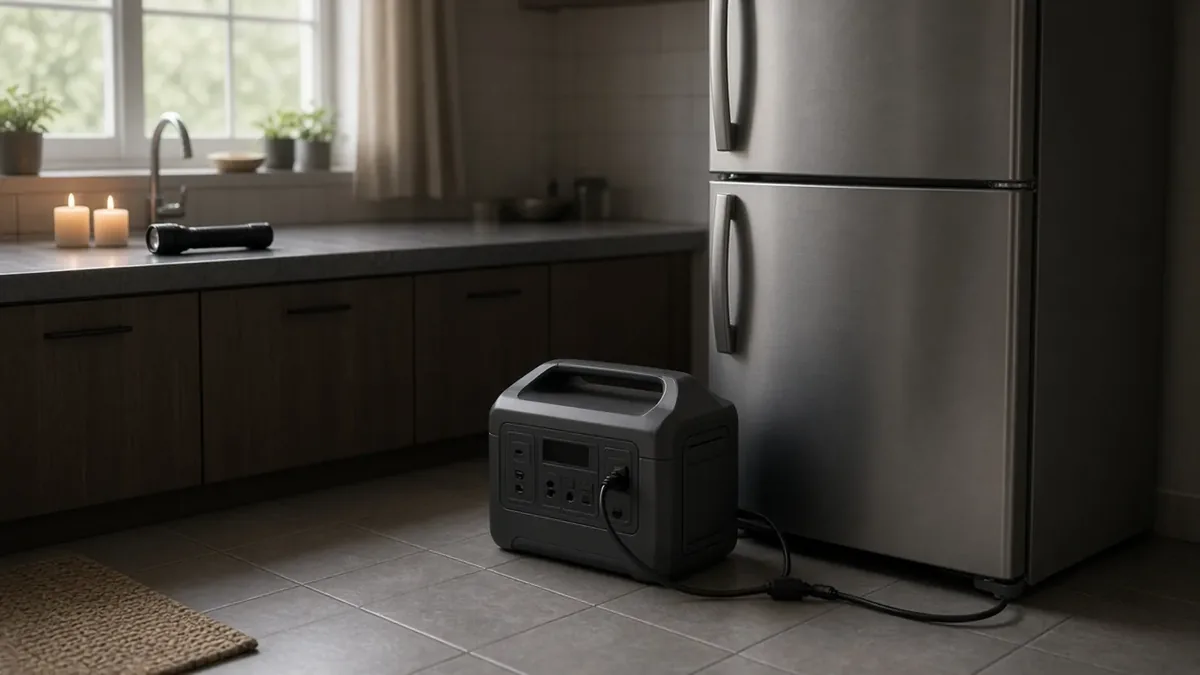
For model-specific advice on the loads above, see our guides to a portable power station for a refrigerator, a portable power station for a sump pump, a portable power station for an air conditioner and a portable power station for CPAP.
Continuous output, surge and outlet limits
Start with the continuous AC output, not the largest number printed in an advertisement. A station may publish both a running rating and a larger peak figure. Peak power is typically time-limited and shouldn't be treated as a second continuous rating. Motor-driven devices, including compressors and pumps, can draw more at startup than while running.
Then check how the output is shared. The total station rating may be split across several outlets, while each receptacle, circuit or port has its own limit. Confirm the voltage, frequency, waveform, outlet rating and any simultaneous-use rule. Add the running demand of devices that will operate together, then leave headroom for startup events rather than planning right at the ceiling.
| Label or spec | What it answers | What it does not answer |
|---|---|---|
| 2,000W continuous AC | Possible sustained inverter output under stated conditions. | Battery size, runtime or each outlet's individual limit. |
| Peak / surge watts | Short-duration starting capability, when the duration is documented. | A rating that can be used continuously. |
| Boost modes (e.g., Power Lifting) | Extra output for resistive loads such as heaters and kettles. | Motor starting capability or a higher continuous rating. |
| Battery capacity in Wh | Stored energy before losses and reserve. | How much power the inverter can deliver at once. |
| Solar input watts | The manufacturer's maximum PV charging input under its conditions. | The inverter's AC output or a guaranteed daily solar harvest. |
Runtime depends on watt-hours, not the 2000W label
A 2000W inverter can sit on top of a much smaller or larger battery, so the output rating tells you nothing about runtime by itself. Using the formula above with a 2,000 Wh battery at ~85% (about 1,700 usable Wh):
| Average load | Calculation | Rough estimate |
|---|---|---|
| 250 W | 1,700 ÷ 250 | about 6.8 hours |
| 500 W | 1,700 ÷ 500 | about 3.4 hours |
| 1,000 W | 1,700 ÷ 1,000 | about 1.7 hours |
| 1,500 W | 1,700 ÷ 1,500 | about 1.1 hours |
| 2,000 W | 1,700 ÷ 2,000 | about 50 minutes |
Actual results vary with the battery, temperature, inverter load, cycling devices, idle draw and low-battery cutoff. Bluetti's own FAQ formulas differ slightly by model: it uses 90% depth of discharge and 85% efficiency (plus self-consumption) for the Elite 200 V2, and 95% depth of discharge and 93% efficiency for the AC200L. Our flat 0.85 sits between those, and it's a fair planning number for any 2 kWh station.
2000W vs 1000W vs 3000W: which size do you need?
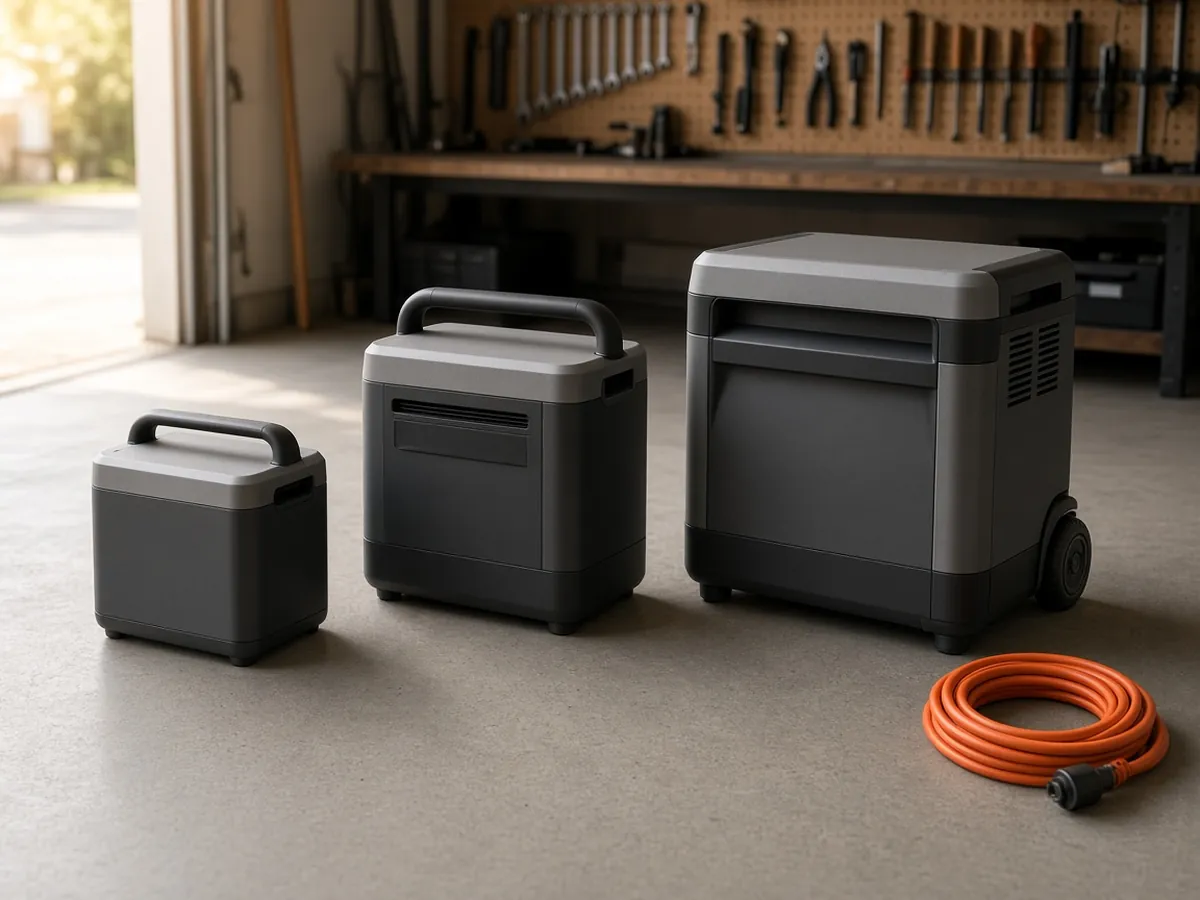
The wattage class mostly decides what you can run at once. The battery decides how long. Stations in each class often ship with a battery of roughly matching size, but not always, so read the Wh on the spec sheet.
| 1000W class | 2000W class | 3000W class | |
|---|---|---|---|
| Continuous output | ~1,000 W | ~2,000 W | ~3,000 W |
| Runs at once (typical) | Fridge, CPAP, laptop, lights, router, TV; small microwave or coffee maker on its own | One big 120 V load (1,500 W heater, microwave, 1/2 HP sump pump, circular saw) plus small electronics | Two big 120 V loads, or one plus a fridge; some models add 240 V output |
| Runtime at 500 W (if battery Wh ≈ class) | ~1.7 h on 1,000 Wh | ~3.4 h on 2,000 Wh | ~5.1 h on 3,000 Wh |
| Fridge at ~80 W average (same assumption) | ~10.6 h | ~21 h | ~32 h |
| Best for | Camping, van life, CPAP, short outages for essentials | Home backup for essentials, RV, job sites | Longer outages, multiple large loads, panel-connected backup |
| Main trade-off | Can't start many motor loads | Heavier; usually wheeled or a two-hand lift | Heaviest and largest; plan for a fixed spot |
Rule of thumb: if your list contains one appliance over about 1,000 W, or a motor load like a sump pump or fridge you want to run alongside other things, go 2000W. If you need two large loads at the same time, or 240 V, look at 3000W and up. Our portable power station 1000W guide and 3000 watt solar generator for home guide cover the neighboring classes in detail.
Best 2000W portable power stations: the two picks compared
All figures below are from Bluetti's official US product pages, read on October 27, 2026. They're manufacturer specs, not our test results. Check the current listing before you buy, because specs and bundles change.
| Bluetti Elite 200 V2 | Bluetti AC200L (discontinued) | |
|---|---|---|
| Best for | Home backup, highest output | RV, expandable system |
| Battery capacity | 2,073.6 Wh, LiFePO₄ | 2,048 Wh, LiFePO₄ |
| Continuous AC output | 2,600 W, 120 V, pure sine wave | 2,400 W total, 120 V, pure sine wave |
| Boost / surge | 3,900 W Power Lifting (resistive loads only) | 3,600 W surge |
| RV outlet | No dedicated high-current RV port (per Bluetti's FAQ) | 1 × 120 V/30 A NEMA TT-30 |
| AC charging input | 1,800 W max | 2,400 W max |
| Solar input | 1,000 W max, 12–60 V, 20 A | 1,200 W max, 12–145 V VOC, 15 A |
| Expandable | No (per Bluetti's FAQ) | Yes, Bluetti batteries only (up to 8,192 Wh with 2 × B300) |
| UPS switchover | Within 15 ms (Bluetti FAQ) | Within 20 ms (Bluetti FAQ) |
| Weight | 53.4 lb (24.2 kg) | 62.4 lb (28.3 kg) |
| Est. runtime at 1,000 W (Wh × 0.85) | ~1.8 h | ~1.7 h |
Bluetti Elite 200 V2: best for home backup and highest output
The Elite 200 V2 has the most continuous output here, 2,600 W, on a 2,073.6 Wh battery. That leaves about 600 W of headroom over a 2,000 W load, which matters when a fridge compressor kicks on while the microwave is running. Its 3,900 W Power Lifting mode lets resistive appliances such as a kettle or space heater run above the rated output, but Bluetti limits it to pure resistive loads, so size pumps and compressors against 2,600 W. Bluetti's FAQ lists a UPS function that switches within 15 ms, which suits a fridge, router or CPAP kept plugged in through short outages. It's lighter than the AC200L at 53.4 lb. It doesn't expand, and Bluetti's FAQ notes it isn't designed to power an entire RV system.
Choose it if: you want the most output in a 2 kWh box for outages at home and don't need extra batteries later.
Bluetti AC200L: best 2000W power station for an RV
Status: Bluetti's US store lists the AC200L as discontinued (checked November 1, 2026).
The AC200L is the RV-friendly one. Its 120 V/30 A NEMA TT-30 outlet takes a standard 30 A RV shore-power cord, so you can feed the camper's 120 V circuits within the station's 2,400 W limit (the RV's air conditioner may still be too much, see the FAQ). Its solar input accepts up to 1,200 W across a wide 12–145 V window, which lets you wire roof or portable panels in series. AC charging reaches 2,400 W, and you can add Bluetti expansion batteries later. Bluetti's FAQ lists combinations up to 8,192 Wh. The trade-off is weight: 62.4 lb.
Choose it if: you camp in an RV or trailer, want serious solar input, or plan to grow the system.
For a model-level comparison with Jackery's 2 kWh station, see our Bluetti vs Jackery comparison. RV owners should also read the portable power station for RV guide on 30 A vs 50 A hookups.
How we chose
- Output that clears 2,000 W continuous. Both picks are rated above 2,000 W on AC, so a full 2000W load doesn't sit at the ceiling.
- About 2 kWh of battery. Enough for a day of refrigerator use or an hour-plus of a 1,500 W load.
- Published, complete specs. We only list numbers we could read on the manufacturer's official US pages, and cite them in Sources.
- One clear job each. One pick for home backup and peak output, one for RVs and expansion.
- What we didn't do. We haven't bench-tested these units, and we don't publish ratings or prices. Other 2 kWh stations from other brands can also fit. Compare continuous watts, surge, Wh and outlets the same way.
Solar charging is another separate rating
A 2,000W AC inverter doesn't imply a 2,000W solar input. Check the solar input's maximum power, voltage range, current limit and connector, and confirm the panels you plan to use fit those limits. The two picks show the difference: the Elite 200 V2 takes up to 1,000 W at 12–60 V, while the AC200L takes up to 1,200 W at 12–145 V. Panel nameplate watts aren't a promise of the same output in the field. Orientation, shade, clouds, temperature and season all affect production. The U.S. Department of Energy distinguishes power capacity from stored energy and notes that storage systems lose some energy during charging and discharging.
A practical 2000W checklist
- Verify that 2,000W is continuous output, or find the continuous rating separately from peak power.
- Check the individual outlet and combined-output limits, voltage and waveform (pure sine wave for motors and electronics).
- Record battery capacity in Wh. Don't infer it from the output rating.
- For motors and compressors, check the startup demand against the station's surge rating and its duration.
- Check solar and wall input limits separately from AC output.
- For RV use, confirm a TT-30 (30 A) outlet if you want to plug in the shore-power cord.
- For home circuits, 240 V equipment or a transfer connection, use manufacturer-approved equipment and a qualified electrician. Never backfeed a panel.
FAQ
How long will a 2000W power station last?
Can a 2000W power station run a refrigerator?
Can a 2000W power station run an air conditioner?
Is 2000W enough to power a house?
Can a 2000W power station run a sump pump?
Does 2000W mean a 2,000Wh battery?
Can a 2000W power station power an RV?
Related guides
- Portable power station wattage calculator
- Portable power station runtime calculator
- Portable power station 1000W guide
- 3000 watt solar generator for home
- Portable power station for a refrigerator
- Portable power station for a sump pump
- Portable power station for an air conditioner
- Portable power station for CPAP
- Portable power station for RV
- Bluetti vs Jackery comparison
Sources
- Bluetti US, Elite 200 V2 product page, spec block and FAQ (2,073.6 Wh LiFePO₄; 2,600 W, 120 V, pure sine wave; 3,900 W Power Lifting for pure resistive loads; AC input 1,800 W; solar 1,000 W, 12–60 V, 20 A; not expandable; UPS within 15 ms; runtime formula with 90% DoD and 85% efficiency; 53.4 lb / 24.2 kg; FAQ on no higher-current RV port).
- Bluetti US, AC200L product page, spec block and FAQ (2,048 Wh LiFePO₄; 4 × 120 V/20 A outlets + 1 × 120 V/30 A NEMA TT-30, 2,400 W total; surge 3,600 W; pure sine wave; AC input 2,400 W; solar 1,200 W, VOC 12–145 V, 15 A; expansion up to 8,192 Wh with 2 × B300; UPS within 20 ms; runtime formula with 95% DoD and 93% efficiency; 62.4 lb / 28.3 kg). Checked again November 1, 2026: every AC200L option is listed as discontinued.
- NIST, definition of the watt.
- U.S. Department of Energy, Solar Energy and Storage Basics.
- Appliance wattages in the "what it runs" table are typical, rounded values from common appliance ratings and generator sizing charts, not measurements of specific products. Check your own device's nameplate.
Planning guide · United States context · Updated November 1, 2026. Runtimes are estimates from stated assumptions, not tests. Product lines, firmware, port standards and manufacturer limits change; verify the current manual before buying or connecting a load.