
Quick answer
A compressor mini fridge uses three different wattage figures, and each one matters for a different decision:
| Figure | Typical size | How to get it | Use it for |
|---|---|---|---|
| Running watts | Often cited around 50–100 W | Nameplate amps × 120 V | Outlet or inverter load |
| Average watts | About 20–35 W for ENERGY STAR compacts (190–270 kWh/year) | Energy label | Runtime and electricity cost |
| Startup surge | Several times the running draw | Short spike when the compressor kicks on | Inverter sizing |
The running figure only applies while the compressor is on. Because the compressor cycles on and off, the average is far lower, roughly 0.5–0.75 kWh per day for an ENERGY STAR compact.
One example: an ENERGY STAR-certified 4.5 cu ft compact fridge (Cuisinart 043-1894-4) is rated at 226 kWh per year, against a federal maximum of 293 kWh for its class. That works out to about 0.62 kWh per day, or 26 W on average.
Running watts vs average watts vs startup surge
- Running watts are what the fridge pulls while the compressor runs. Find them on the nameplate inside the door or on the back. If only amps are listed, multiply amps × 120 V (Virginia Cooperative Extension's method). The label number is a maximum, so real running draw is often a bit lower.
- Average watts account for the compressor's off time. The most reliable source is the yellow EnergyGuide label or ENERGY STAR listing: average watts = kWh per year × 1,000 ÷ 8,760 hours.
- Startup surge is a brief spike when the compressor motor starts. Virginia Cooperative Extension notes motors can draw about three times their running current at startup. Honda's generator guide lists a full-size ENERGY STAR refrigerator at 132–192 running watts and 1,200 starting watts, so plan for a spike well above the running number.
Thermoelectric (no-compressor) coolers work differently. They draw steadily rather than cycling, so their label watts are close to their average. Check the label.
Mini fridge kWh per day: from label to watts
| Label kWh/year | kWh/day | Average W | 1,000 Wh power station* | 2,000 Wh power station* |
|---|---|---|---|---|
| 150 | 0.41 | ~17 W | ~24 h | ~48 h |
| 200 | 0.55 | ~23 W | ~20 h | ~40 h |
| 226 (example model above) | 0.62 | ~26 W | ~19 h | ~38 h |
| 250 | 0.68 | ~29 W | ~18 h | ~35 h |
| 300 | 0.82 | ~34 W | ~16 h | ~31 h |
*Planning estimate: rated Wh × 0.85 inverter efficiency × 0.90 reserve ÷ (average W + 15 W station overhead). Label kWh comes from a standardized DOE test. A warm room, frequent door openings, a colder setting or a fridge full of warm drinks will raise real use.
Why the 15 W overhead matters: a power station's inverter and electronics draw power the whole time the AC outlet is on. Bluetti's published runtime formula uses about 15 W, and Jackery lists 18 W standby for the Explorer 1000 v2. Against a fridge averaging 26 W, that overhead cuts runtime by more than a third. Leave it out and the 1,000 Wh estimate rises to about 30 hours, which is too optimistic.
Electricity cost: kWh per year × your rate per kWh. For the example model, that's 226 × your rate.
Can a power station run a mini fridge?
Yes, most can. Check two things:
- Output and surge. The station's continuous AC output should comfortably exceed the fridge's running watts, and its surge rating should handle the startup spike. A typical 1 kWh-class station (1,500–1,800 W continuous) has plenty of headroom for one mini fridge. Small stations under about 300 W continuous can struggle with compressor starts, so check the manual.
- Battery energy. Use the table above, or plug the average watts (plus overhead) into the runtime calculator.
Tips for longer runtime
- Pre-chill the fridge and its contents on grid power before switching over.
- Keep it out of the sun and away from heat, with clearance around the vents.
- Open it as little as possible, and don't set it colder than you need.
- Turn off the station's low-load auto-off if it cuts power while the compressor is idle. Check the manual for the setting.
For full-size refrigerators and multi-day outages, see our portable power station for refrigerator guide. For RVs and camping setups, see power station for RV and off-grid camping.
How to measure your own mini fridge
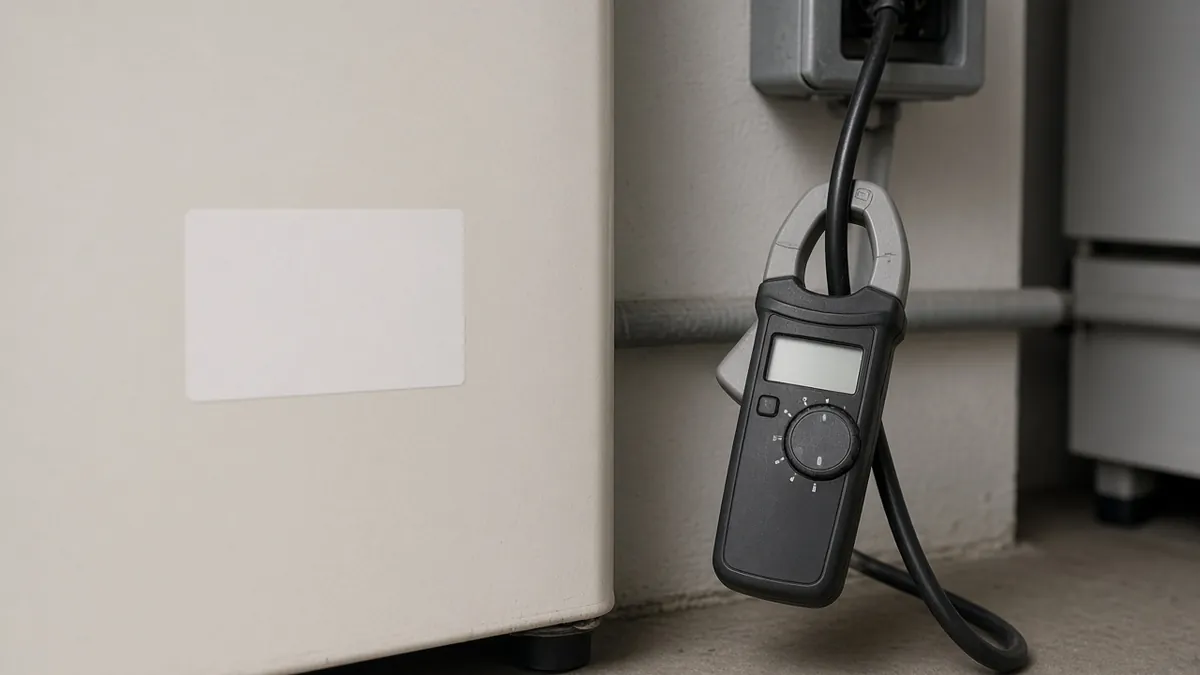
- Plug the fridge into a plug-in watt meter, or read the station's output display.
- Let it run 24 hours in its normal spot with normal use.
- Read the kWh, then divide by 24 for average kW (× 1,000 for watts).
- Note the peak watts shown when the compressor starts, if your meter records it.
This beats any published figure, because room temperature and how you use the fridge change the result.
FAQ
How many watts does a mini fridge use?
How many kWh does a mini fridge use per day?
What are a mini fridge's starting watts?
How long will a 1000Wh power station run a mini fridge?
Will a 300W power station run a mini fridge?
Do mini fridges use a lot of electricity?
Related guides
Sources
- ENERGY STAR, Certified Residential Refrigerators product finder (compact models; example Cuisinart 043-1894-4 at 226 kWh/yr vs 293 kWh/yr federal standard). https://www.energystar.gov/productfinder/product/certified-residential-refrigerators/results
- Virginia Cooperative Extension, Estimating Appliance and Home Electronic Energy Use (BSE-301; watts = volts × amps; motor starting current). https://www.pubs.ext.vt.edu/content/dam/pubs_ext_vt_edu/2901/2901-9014/BSE-301.pdf
- Honda Power Equipment, What Wattage Generator Do I Need? (refrigerator running and starting watts). https://powerequipment.honda.com/generators/generator-wattage-estimation-guide
- Bluetti AC180 FAQ (runtime formula with ~15 W self-consumption); Jackery Explorer 1000 v2 basic information (18 W standby). https://www.bluettipower.com/products/ac180 · https://faq.jackery.com/hc/en-us/articles/52303615153051-Explorer-1000-V2-Basic-Information
Planning guide · United States context · Published October 5, 2026.