
Quick answer
A 5,000-watt generator can usually run a home's outage essentials at the same time: a refrigerator, a sump pump, a furnace fan, lights, a TV and phone chargers. Or it can run a window air conditioner plus a fridge and lights. It won't run a whole house. An electric dryer, an electric range or an electric water heater on top of other loads is beyond it, and central air depends heavily on the unit.
The answer depends on two numbers on the spec sheet:
- Running (rated) watts: what the generator can supply continuously.
- Starting (surge/peak) watts: the short burst it can deliver while motors and compressors start.
Many generators are marketed by their starting watts. Check whether "5,000 W" is the running or the starting figure before you plan around it.
Looking at a battery-based "5,000 W solar generator" instead? Its limits work differently (battery watt-hours set the runtime). See our solar generator 5,000 watts guide.
Appliance watts: running vs starting
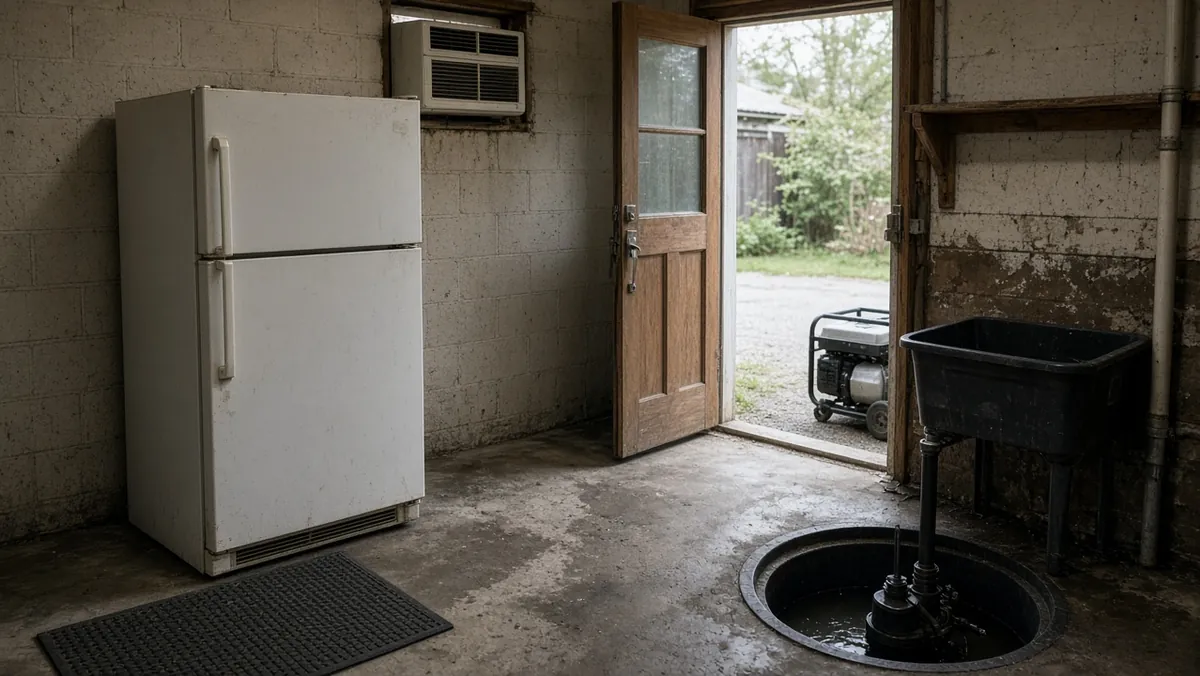
Typical figures from Honda's generator wattage guide. Your appliance's nameplate is always the better number.
| Appliance | Running watts | Starting watts | On a 5,000 W generator |
|---|---|---|---|
| Refrigerator/freezer (Energy Star) | 132–192 | 1,200 | Yes |
| Sump pump, 1/3 HP | 800 | 1,300 | Yes |
| Sump pump, 1/2 HP | 1,050 | 2,150 | Yes |
| Furnace fan, 1/2 HP | 875 | 2,350 | Yes, if the generator outlet/transfer setup matches the furnace's voltage |
| Window AC, 10,000 BTU | 1,500 | 2,200 | Yes, but stagger starts with other motors |
| Microwave, 1,000 W | 1,500 | 1,500 | Yes, not alongside everything else |
| Coffee maker | 600 | 600 | Yes |
| Washing machine | 1,200 | — | Yes, when other big loads are off |
| Garage door opener | 720 | 1,420 | Yes |
| Space heater (radiant) | 1,300 | 1,300 | Yes, it uses a big share of capacity |
| TV (46 in) | 190 | 190 | Yes |
| Laptop | 200–250 | — | Yes |
| Electric water heater | 4,500 (240 V) | 4,500 | Only by itself, and only with a 240 V connection |
| Electric clothes dryer | 5,400 (240 V) | 6,750 | No |
"—" means Honda lists no separate starting figure.
How to size the load: Honda's method
- List what must run at the same time.
- Add their running watts.
- Add the single highest starting wattage from that list. Honda's guide suggests this as a safety margin, because only one motor usually starts at a time.
- Compare: the running total must stay under the generator's running watts, and the step-3 total under its starting watts.
Our wattage calculator uses the same logic for battery stations.
Example 1: outage essentials
| Load | Running W | Starting W |
|---|---|---|
| Refrigerator | 192 | 1,200 |
| Sump pump, 1/2 HP | 1,050 | 2,150 |
| Furnace fan, 1/2 HP | 875 | 2,350 |
| LED lights (example: ten 10 W bulbs) | 100 | — |
| TV | 190 | — |
| Total running | 2,407 W | |
| + highest starting (furnace fan 2,350) | 4,757 W |
That fits a generator rated about 5,000 W starting and comfortably above 2,400 W running. You'd still have room for phone chargers and a modem, but not for a microwave plus a space heater on top.
Example 2: window AC, fridge and kitchen
| Load | Running W | Starting W |
|---|---|---|
| Window AC, 10,000 BTU | 1,500 | 2,200 |
| Refrigerator | 192 | 1,200 |
| Microwave, 1,000 W | 1,500 | 1,500 |
| TV + lights | 290 | — |
| Total running | 3,482 W | |
| + highest starting (AC 2,200) | 5,682 W |
That's over a 5,000 W starting rating by Honda's conservative method. The fix is to stagger: don't run the microwave while the AC is cycling on. Without the microwave, the totals are 1,982 W running and 4,182 W with the AC start, which fits.
What a 5,000 W generator usually can't run
- The whole house at once. Add up a typical kitchen, laundry and HVAC and you'll exceed it quickly.
- Electric dryers, ranges and ovens. These are 240 V loads of several thousand watts each.
- Electric water heaters alongside anything else (4,500 W running in Honda's list).
- Central air conditioning, often. Requirements vary widely with system size and how hard the compressor is to start. Check the outdoor unit's nameplate and ask an HVAC pro or electrician. Some setups need a larger generator or a soft-start kit.
- Well pumps: many are 240 V and have large starting surges. Check the pump's horsepower and voltage before counting on it.
Connect it safely
- Outdoors only, at least 20 feet from the house, with the exhaust pointed away from doors, windows and vents. CPSC warns never to run a generator in a home, garage, basement, crawlspace, shed or on a porch, even with doors or windows open.
- Install battery or battery-backup CO alarms on every level and outside sleeping areas.
- No backfeeding. Never plug a generator into a wall outlet. To power hardwired loads such as a furnace fan, sump pump or well pump, have an electrician install a transfer switch or interlock.
- Use heavy-duty outdoor extension cords rated for the load when plugging appliances in directly.
- Fuel safely. Shut it off and let it cool before refueling, and store fuel away from living spaces.
Gas generator or battery "solar generator"?
| 5,000 W gas/inverter generator | 5,000 W battery power station / solar generator | |
|---|---|---|
| Limit you hit first | Running watts | Battery watt-hours (runtime) |
| Runtime | As long as you have fuel | Hours, depending on Wh and load; solar can recharge |
| Indoor use | Never | Designed for indoor use per the manual |
| Noise and fumes | Engine noise, CO exhaust | Quiet, no exhaust |
| Read next | This page | Solar generator 5,000 watts · solar vs gas generator |
FAQ
Will a 5000 watt generator run a house?
Can a 5000 watt generator run central air?
Will a 5000 watt generator run a refrigerator and freezer?
How many watts do I need to run a house during an outage?
What's the difference between running and starting watts?
Can I plug a 5000 watt generator into my house?
Related guides
Sources
- Honda Power Equipment, What Wattage Generator Do I Need? (running and starting watts by appliance; sizing method). https://powerequipment.honda.com/generators/generator-wattage-estimation-guide
- U.S. Consumer Product Safety Commission, Portable Generator Hazards. https://www.cpsc.gov/safety-education/safety-guides/carbon-monoxide/portable-generator-hazards
Planning guide · United States context · Published October 5, 2026.