Quick answer
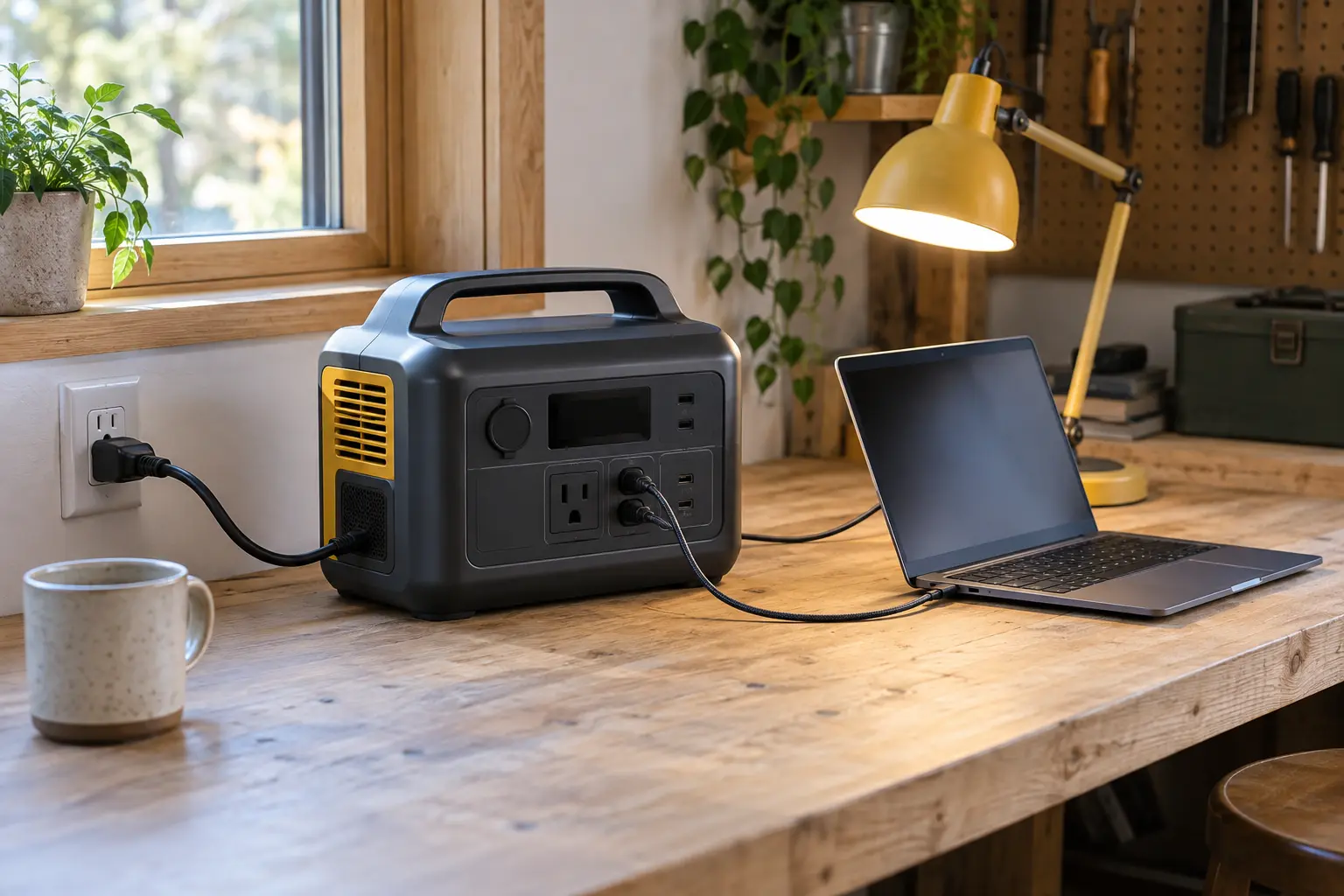
With pass-through charging, the station is connected to an external source such as a wall outlet while it powers one or more outputs. Depending on the design, the incoming power may feed the outputs directly, charge the battery while the inverter supplies the load, or switch between paths under specific conditions. Those behaviors are not interchangeable.
Example station: Bluetti Elite 100 V2. Lists a UPS switchover of 10 ms or less, with a 1,024 Wh battery and 1,800 W AC output. Check that switchover time against what your device needs.
How the power path can behave
A portable power station combines an input charger, battery, inverter and output controls. Pass-through charging makes those parts operate at the same time, but the internal route differs by model and mode.
| Situation | What may happen | What to verify |
|---|---|---|
| Grid power available | The station accepts AC input while an output remains active. | Maximum combined input/output load and whether the battery is also charging. |
| Grid power fails | The station may transfer to battery power, stop the output briefly or shut down. | Published transfer time, operating mode and behavior with your load. |
| Battery reaches its reserve | The station may keep the output on, reduce power or stop to protect the battery. | Minimum state of charge and low-battery cutoff. |
| Input is restored | The charger may resume automatically or require a button/app setting. | Restart behavior, firmware requirements and charging priority. |
The product display may show input and output watts at the same time, but that screen alone does not prove how quickly the station transfers during an outage or whether a sensitive device stays connected.
Pass-through charging versus UPS or EPS mode
People often use these terms together, but the labels describe different questions. Pass-through asks whether the station can accept energy and power a load at the same time. UPS or EPS mode usually adds a documented transfer behavior intended to keep a connected load powered when the input source changes.
| Feature | Pass-through charging | UPS / EPS-style mode |
|---|---|---|
| Main purpose | Run outputs while an external source is connected. | Reduce interruption when input power changes. |
| Transfer promise | May be unspecified or model-dependent. | Should have a stated transfer time or operating description. |
| Load limits | May be lower during charging or bypass operation. | Still limited by output, surge, temperature and mode rules. |
| Best use | Desk equipment, routers or a short continuity test. | Only the loads and conditions the manual explicitly supports. |
Do not connect a medical, life-safety or hardwired system based on the phrase “UPS” alone. Read the manual, understand the transfer gap and use equipment approved for the exact application.
When pass-through charging is useful
Reasonable planning cases
- Keep a router, modem or small desk setup powered while the station is plugged in.
- Use a temporary battery bridge for a laptop or communication load during a short outage.
- Maintain a charged station in a cabin, RV or workshop while occasionally powering a low-load device.
- Test the complete input, output and transfer path before depending on it in an outage.
Cases that need extra caution
- Any load where even a short interruption can corrupt data or create a safety issue.
- High-wattage heaters, compressors, pumps or several motor loads starting together.
- A home panel, transfer switch or backfeed arrangement without approved equipment and a qualified electrician.
- A station operating in heat, moisture, dust or a location with blocked cooling airflow.
A verification checklist before relying on it
- 01Find the exact model manual and search for “pass-through,” “UPS,” “EPS,” “bypass,” “transfer time” and “charging while discharging.”
- 02Record the continuous output, peak output, input limit and any lower limit that applies when the station is charging.
- 03List the connected load and estimate its demand with the wattage calculator. Keep startup watts separate from runtime watts.
- 04Check whether AC, USB-C, 12V and other outputs behave the same way. A pass-through statement for one port does not automatically cover every port.
- 05Run a supervised test with a non-critical load: connect the station to the wall, power the load, unplug the wall input and observe the output, delay, alarm and restart behavior.
- 06Estimate the battery window with the runtime calculator and keep a reserve. A pass-through setup still needs battery energy when the input disappears.
What can shorten battery life or runtime
When the station is simultaneously charging and discharging, heat, conversion losses and repeated cycling can change the result. A small load may also trigger a low-load shutdown, while a motor load can exceed the inverter’s peak limit even if its average watts look acceptable.
- Use the manufacturer’s charging temperature and ventilation guidance.
- Do not assume the wall input supplies the full output indefinitely; check the combined power limit.
- Keep firmware and operating mode documented if the manual says behavior can change after an update.
- Compare the target duration with usable watt-hours, not only the nominal battery number.
- For long-term standby, follow the storage state-of-charge and recharge schedule in the manual.
FAQ
Does pass-through charging mean the battery is always bypassed?
Can pass-through charging keep a computer on during an outage?
Is pass-through charging bad for the battery?
Can I use a pass-through power station as a home backup system?
Planning guide · United States context · Updated October 24, 2026. Product lines, firmware, port standards and manufacturer limits change; verify the current manual before buying or connecting a load.