
Convert Ah, mAh and Wh.
Enter capacity and voltage to get watt-hours, or enter watt-hours and voltage to get amp-hours. The field you didn't type in is the one that updates.
Quick answer
To convert amp hours to watt hours, multiply amp hours by the battery’s nominal voltage: Wh = Ah × V. To go from watt hours to amp hours, divide: Ah = Wh ÷ V. A 12 V, 100 Ah battery stores 1,200 Wh. For mAh, divide by 1,000 first: a 20,000 mAh power bank with 3.7 V cells holds 20 Ah × 3.7 V = 74 Wh. You always need the voltage. Amp hours alone don’t tell you how much energy a battery holds.
How to use the Ah to Wh calculator
| Field | What to enter | Where to find it |
|---|---|---|
| Capacity (Ah or mAh) | The battery’s rated amp-hours, or milliamp-hours for small packs | Battery label, manual or spec sheet |
| Nominal voltage (V) | The battery’s nominal (average) voltage, not its full-charge or USB output voltage | Label or spec sheet. See the voltage table below if only the chemistry is given |
| Energy (Wh) | Watt-hours, if you’re starting from Wh and want amp-hours | Power station spec sheets usually list Wh directly |
Switching the unit between Ah and mAh keeps the watt-hours and rewrites the capacity in the new unit. The note under the result shows a rough AC-side figure at 85% efficiency, the same planning default our runtime calculator uses.
What is a watt hour?
A watt hour (Wh) is a unit of energy: one watt of power delivered for one hour. A 60 W load running for one hour uses 60 Wh. So does a 30 W load running for two hours. Power stations and larger batteries are rated in Wh (or kWh, where 1 kWh = 1,000 Wh) because watt-hours tell you directly how much work the battery can do.
What is an amp hour?
An amp hour (Ah) is a unit of charge: one amp of current flowing for one hour. A milliamp hour (mAh) is one thousandth of that, so 1,000 mAh = 1 Ah. Amp-hours describe capacity at a particular voltage. That’s why a 100 Ah battery at 12 V and a 100 Ah battery at 48 V hold very different amounts of energy: 1,200 Wh versus 4,800 Wh.
Amp hours to watt hours formula (Ah to Wh)
Wh = Ah × V
For milliamp hours: Wh = mAh × V ÷ 1,000
Worked examples:
- 12 V, 100 Ah battery: 100 × 12 = 1,200 Wh.
- 12.8 V, 100 Ah LiFePO4 battery: 100 × 12.8 = 1,280 Wh. A “12 V” lithium iron phosphate battery is usually four 3.2 V cells in series, so 12.8 V is its nominal voltage.
- 20,000 mAh power bank with 3.7 V cells: 20,000 × 3.7 ÷ 1,000 = 74 Wh.
- 24 V, 50 Ah battery: 50 × 24 = 1,200 Wh, the same energy as example 1, at half the amp-hours.
Watt hours to amp hours formula (Wh to Ah)
Ah = Wh ÷ V
For milliamp hours: mAh = Wh ÷ V × 1,000
Worked example: a 1,000 Wh battery expressed in amp-hours at different system voltages:
| System voltage | Calculation | Amp-hours |
|---|---|---|
| 12 V | 1,000 ÷ 12 | 83.3 Ah |
| 24 V | 1,000 ÷ 24 | 41.7 Ah |
| 48 V | 1,000 ÷ 48 | 20.8 Ah |
The energy is the same in every row. Only the way it’s expressed changes. To compare batteries, compare watt-hours.
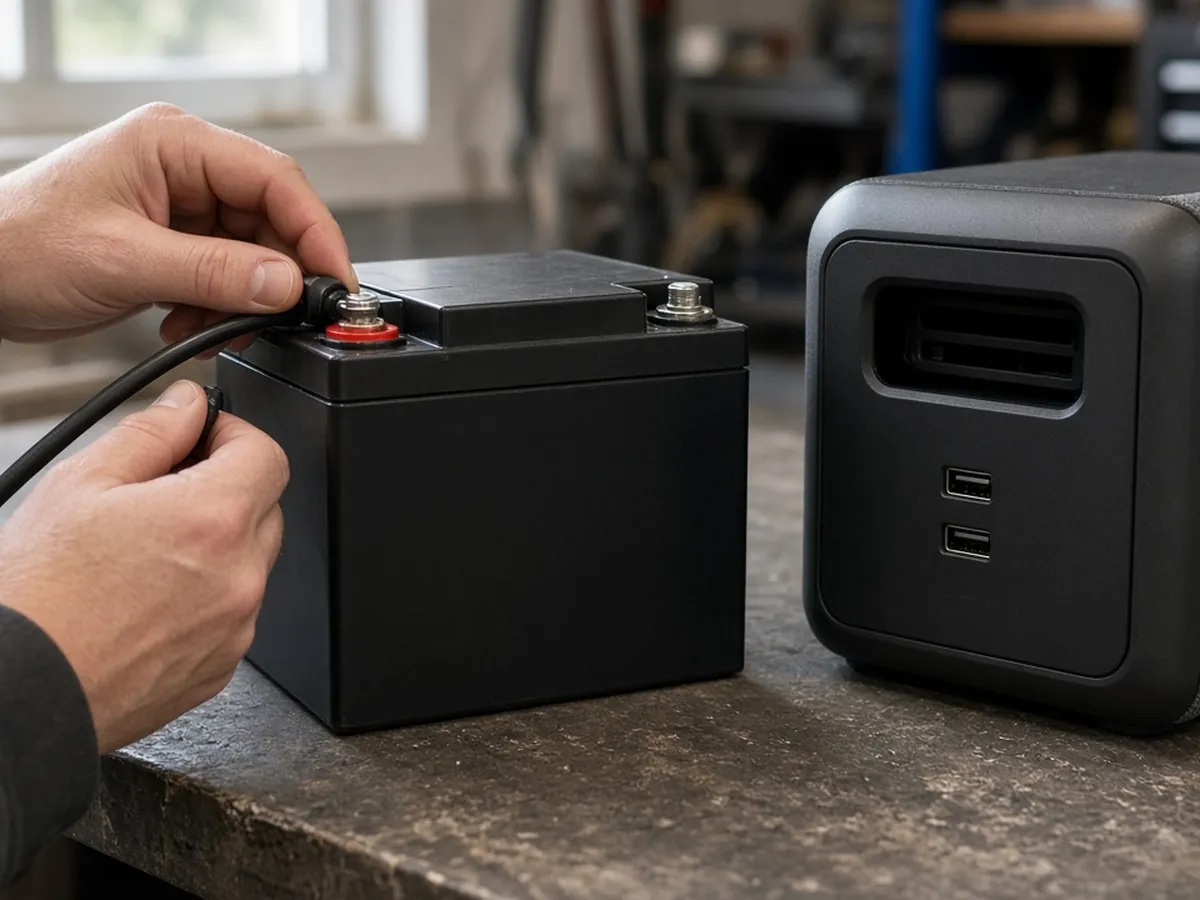
Common battery voltages for Ah to Wh conversions
Use the nominal voltage for the battery’s chemistry and cell count. The Wh column shows what 100 Ah works out to at each voltage, for quick comparison.
| Battery or system | Nominal voltage | 100 Ah equals |
|---|---|---|
| Single Li-ion cell (phones, power banks) | 3.6–3.7 V | 360–370 Wh |
| Single LiFePO4 cell | 3.2 V | 320 Wh |
| 12 V lead-acid (6 cells × 2 V) | 12 V | 1,200 Wh |
| “12 V” LiFePO4 (4 cells in series) | 12.8 V | 1,280 Wh |
| 24 V system | 24 V (25.6 V for 8 LiFePO4 cells) | 2,400 Wh (2,560 Wh) |
| 48 V system | 48 V (51.2 V for 16 LiFePO4 cells) | 4,800 Wh (5,120 Wh) |
Cell voltages come from Battery University’s chemistry summaries (3.6–3.7 V for common Li-ion types, 3.2–3.3 V for LiFePO4, four LiFePO4 cells in series = 12.8 V). The 25.6 V and 51.2 V figures are simply 8 and 16 cells × 3.2 V. Always prefer the voltage printed on your own battery.
Don’t use the USB 5 V output voltage for a power bank. The capacity in mAh is normally the internal cell capacity at about 3.6–3.7 V. Multiplying it by 5 V overstates the energy.
Rated vs usable watt hours
The Ah × V result is the battery’s rated energy. What reaches your devices is lower, for a few general reasons:
- Conversion losses. Turning battery DC into 120 V AC through an inverter, or stepping voltage up or down for USB and 12 V ports, wastes some energy as heat. Our calculators use 85% as a planning default for AC loads. The manual’s own figure, if it publishes one, is better. DC outputs often lose less.
- Depth of discharge. Lead-acid batteries last longer when they aren’t drained deeply. Sandia National Laboratories’ report on sealed lead-acid cells lists roughly 150–200 cycles at 100% depth of discharge versus 400–500 cycles at 50%, which is why many lead-acid systems are planned around using only about half their rated Ah. Lithium packs in power stations are managed by a battery management system, which sets its own cutoffs.
- Temperature and age. Cold batteries deliver less, and all batteries slowly lose capacity over their life. See portable power station battery life.
Worked example: a 12 V, 100 Ah lead-acid battery is 1,200 Wh rated. Using only 50% of it leaves 600 Wh. Through an inverter at 85%, that’s about 510 Wh at the AC outlet. The same rated energy in a lithium pack used to a deeper depth of discharge gives you more usable energy. Plug the usable figure into the runtime calculator to estimate hours, and check that the load fits the inverter with the wattage calculator.
Airline battery limits in watt hours
US airline rules for spare lithium-ion batteries and power banks are written in watt-hours, which is one of the most common reasons to convert mAh to Wh. According to the FAA’s PackSafe page and TSA:
- Up to 100 Wh per battery: allowed, in carry-on bags only for spares and power banks, with terminals protected from short circuit.
- 101–160 Wh: up to two spare batteries per person, with airline approval.
- Spare lithium batteries and power banks are not allowed in checked bags. If a carry-on is gate-checked, spares must be removed and kept in the cabin.
- Many airlines set stricter limits, so check with your carrier before you fly.
The FAA notes that newer lithium-ion batteries have the Wh rating marked on them, and that you can calculate it by multiplying voltage by amp-hours. For a pack with 3.7 V cells, 100 Wh works out to about 27,000 mAh (100 ÷ 3.7 × 1,000 ≈ 27,027) and 160 Wh to about 43,200 mAh. Treat these as rough checks only: the Wh printed on the battery is what counts.

Most portable power stations are rated in the hundreds or thousands of Wh, well above these limits. For how the battery, inverter and outputs fit together, see how a portable power station works. If you’re wiring solar panels, the same Ah and V logic explains why panels in series or parallel change voltage or current but not the power math (watts = volts × amps).
How do I convert amp hours to watt hours?
How do I convert watt hours to amp hours?
How many watt hours is 100Ah?
How do I convert mAh to Wh?
What is a watt hour in simple terms?
Why can't I convert Ah to Wh without voltage?
Is a 20,000 mAh power bank allowed on a plane?
Related guides
Sources
- Federal Aviation Administration: PackSafe – Lithium Batteries. 100 Wh limit per lithium-ion battery; up to two spares of 101–160 Wh with airline approval; spares in carry-on only; Wh = V × Ah tip. Fetched 2026-10-15.
- Transportation Security Administration: Lithium batteries with more than 100 watt hours. Carry-on yes (special instructions), checked no; two spares of 101–160 Wh with airline approval. Fetched 2026-10-15.
- Battery University: BU-205: Types of Lithium-ion. Nominal cell voltages (3.6–3.7 V Li-ion, 3.2–3.3 V LiFePO4), four LiFePO4 cells = 12.8 V, lead-acid 2 V cells. Fetched 2026-10-15.
- Sandia National Laboratories: SAND2004-3149, sealed lead-acid cycle life vs depth of discharge. Fetched 2026-10-15.
Planning guide · United States context · Published October 15, 2026. Battery labels and airline rules change; check the rating printed on the battery and your airline's current policy.