The short answer
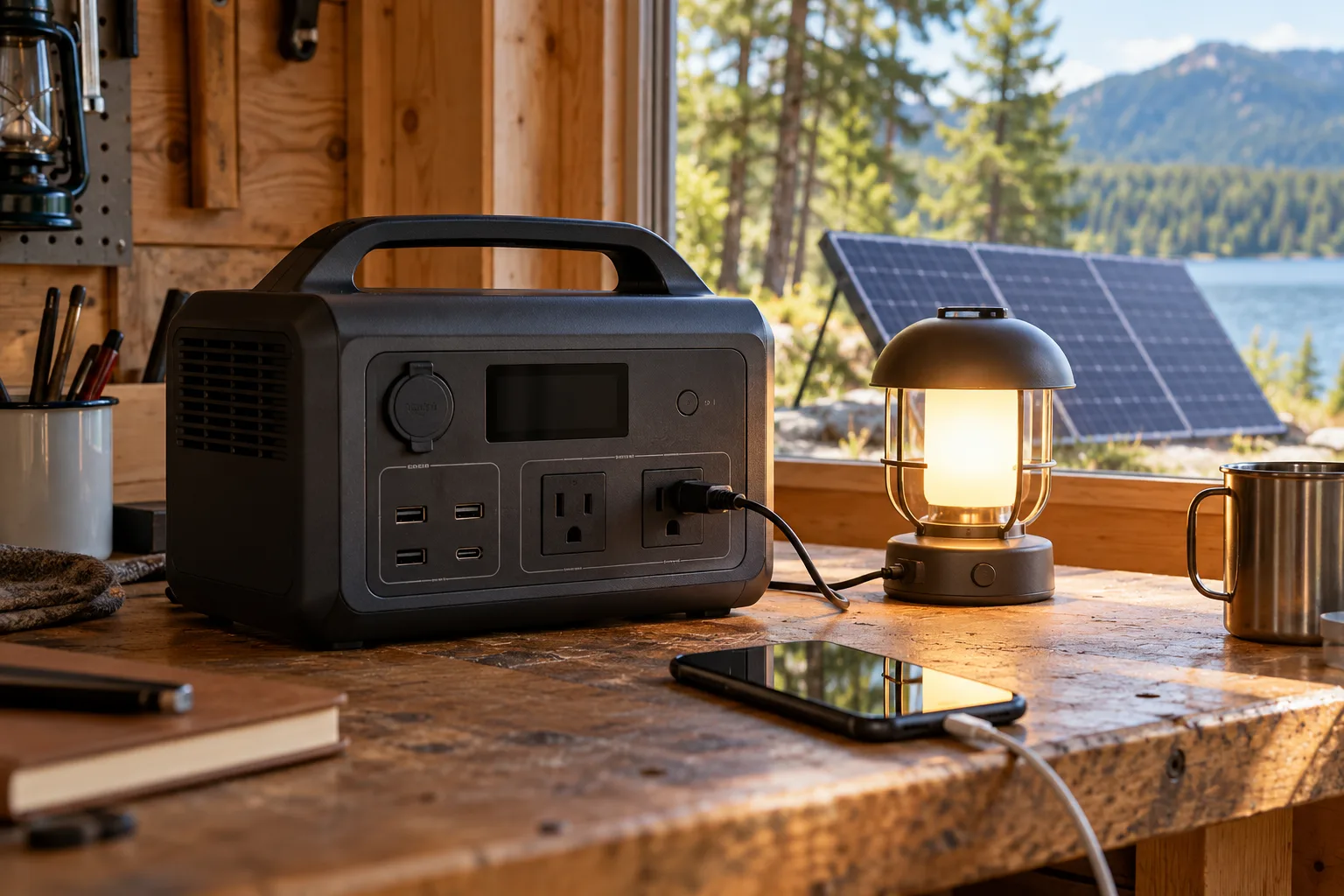
A portable power station stores electricity in a rechargeable battery and routes it to the output a device needs. Charging electronics convert incoming wall, vehicle or compatible solar power for the battery; a battery-management system monitors the cells; and an inverter converts stored DC into AC for standard outlets. USB and other DC ports use regulated direct current. Not every model supports every input, port or operating mode, so the manual is the authority for a specific unit.
What is inside a portable power station?
Think of the unit as four connected jobs rather than one magic battery:
| Part | What it does | What to check on a real unit |
|---|---|---|
| Battery cells | Store energy chemically and release it as direct current (DC). | Chemistry, rated watt-hours (Wh), temperature range and storage instructions. |
| Battery-management system (BMS) | Measures and controls the battery pack so charging and discharge stay within the maker’s limits. | Protection behavior, warnings and any reset or service instructions in the manual. |
| Charging electronics | Adapt power arriving from the supported AC, vehicle or solar input to the battery’s charging requirements. | Input ports, allowed voltage/current, maximum input and compatible cables. |
| Inverter and DC converters | Turn battery output into AC at the outlets or regulated DC at ports such as USB. | Continuous and surge output, outlet voltage/frequency, USB power and port limits. |
The Department of Energy describes inverters as power-electronic devices that convert DC to AC, and describes battery-management systems as monitoring cell measurements and controlling battery operation. A compact consumer station combines these functions in one enclosure, but its internal layout and protections vary by model.
How does the energy move through the unit?
1. Electricity enters through a supported input
An AC wall input begins as alternating current. A charging circuit converts it to the DC form the battery can accept. A solar input starts with DC from photovoltaic panels and may pass through a charge controller or maximum-power-point-tracking stage before reaching the battery. A vehicle input has its own voltage and current ceiling. A plug that physically fits is not proof that the source is electrically compatible.
2. The battery stores energy
Battery cells do not hold a tank of ready-made AC electricity. They store energy through electrochemical processes and provide DC as the station discharges. The display’s state-of-charge estimate is useful for planning, but it is not a precision fuel gauge; load, temperature and the model’s reserve can affect the percentage and the energy available at a port.
3. The BMS supervises charging and discharge
The BMS collects measurements such as cell voltage and temperature and applies the device maker’s limits. If a measurement, temperature or load crosses a protection threshold, the station may reduce output, stop charging or show an error. Do not bypass a warning, open the case or treat a repeated fault as a setting to work around.
4. The output stage serves the device
USB and some 12-volt ports deliver regulated DC. An AC outlet needs an inverter to turn battery DC into alternating current. The inverter’s continuous-watt rating describes a power ceiling; a surge rating, if supplied, covers only the short startup period stated by the manufacturer. A device must fit the right output, not just the outlet shape.
Why are watts and watt-hours different?
Watts (W) measure the rate of power. Watt-hours (Wh) measure stored energy. The inverter rating helps answer whether a station can run a device at a moment in time. The battery’s Wh rating helps estimate how long it might run. A high-watt inverter does not automatically mean a large battery, and a large battery does not automatically mean the inverter can start a motor.
For a first-pass runtime estimate, divide battery Wh by the device’s watts. The result is optimistic because the full rated capacity may not be available at the outlet: conversion losses, the station’s reserve, standby draw and changing device demand all matter. Use the actual load and a conservative usable-energy assumption in our portable power station runtime calculator. For output sizing, use the wattage calculator and check motor startup separately.
Why does the outlet deliver less energy than the battery rating?
Every conversion and control stage uses some energy. Inverter operation also creates heat, and the station may stop before the cells are completely depleted to protect the battery. That is why a 1,000 Wh battery should not be treated as 1,000 Wh guaranteed at an AC outlet. Direct DC output may avoid the inverter stage, but it still has device-specific conversion and standby losses.
Treat the nameplate as a comparison point, not a promise. To estimate a real setup, record the device’s measured or documented draw, whether it cycles, which output you will use, and how much reserve you want left.
What changes between models?
The energy-flow idea is common, but important specifications are not universal:
- Battery chemistry and pack design: chemistry changes operating limits and the manufacturer’s care instructions.
- Solar input: maximum voltage, current, connector, panel configuration and controller behavior are model-specific.
- AC output: continuous watts, short surge capability, voltage and frequency differ across markets and units.
- USB output: a USB-C port may have a different power profile from another USB-C port on the same station.
- Pass-through or backup mode: some units can charge while supplying a load, and some advertise EPS/UPS behavior. Transfer time and supported conditions must be confirmed in that exact manual; a power station is not automatically a whole-home backup system.
If you want to connect solar, start with the solar charging guide and series-versus-parallel panel checks. For a household appliance, compare its nameplate and startup needs with the station’s stated AC limits before plugging it in.
A safe way to learn your station
- Read the manual for the exact model and note its allowed inputs, outputs and operating temperatures.
- Start with one small, known-compatible load and watch the display.
- Compare the device’s draw with the output rating; do not use the battery percentage as a substitute for watts.
- Disconnect before changing panel wiring or adapters, and stay inside published electrical limits.
- Stop if a cable is damaged, a connector is unusually hot, the case is damaged or a warning repeats. Use the manufacturer’s support route.
Do not connect a portable station to a home circuit by plugging its AC outlet into a wall receptacle. Backfeeding can create a serious shock and fire hazard. A home transfer connection requires equipment and installation approved for that purpose.
FAQ
Does a portable power station make electricity?
No. It stores energy supplied from another source and converts it into outputs that connected devices can use. A solar panel can recharge it when the station supports that input and the panel stays within the station’s limits.
Does every portable power station have an inverter?
No. A unit with AC outlets needs an inverter, but a DC-only battery pack may have no AC outlet. Check the ports and specifications rather than relying on the product category name.
Can I use solar panels while powering a device?
Some stations support simultaneous input and output, but accepted power and operating conditions vary. Check the manual for pass-through charging, temperature limits and any restrictions before testing it.
Is a power station the same as a gas generator?
No. A portable power station stores energy in a battery and has no combustion engine. It must be recharged from an external source; its inverter, battery and input limits determine what it can supply.
Sources
- U.S. Department of Energy: Solar Integration — Inverters and Grid Services Basics — how an inverter converts DC to AC.
- U.S. Department of Energy: Solar Power Electronic Devices — conversion and battery charging roles of power electronics.
- U.S. Department of Energy: Battery Energy Storage components and functions — overview of battery, BMS and inverter roles in storage systems.