The short answer
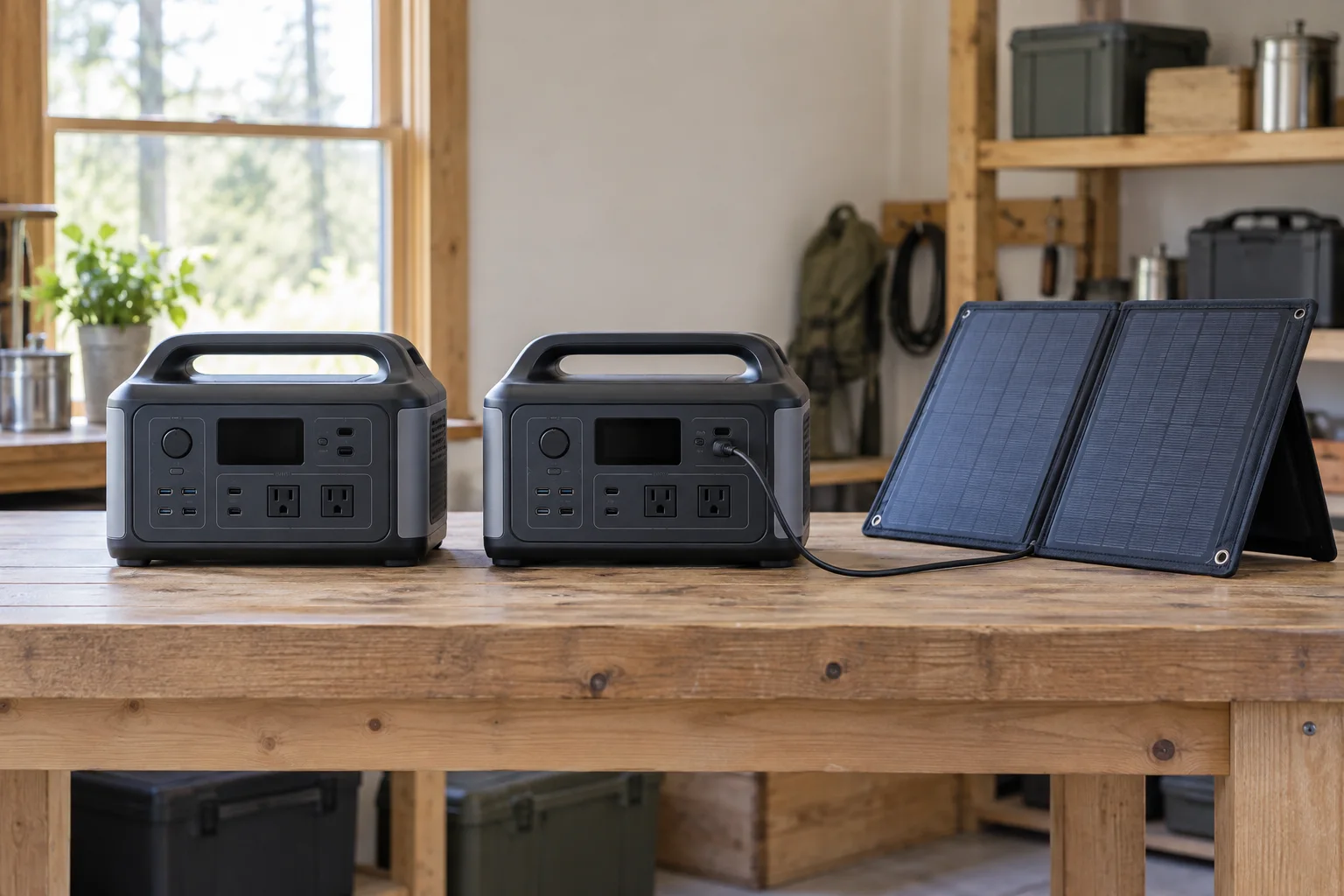
A portable power station stores energy in a battery and supplies it through AC, DC or USB outputs. A solar generator usually means a portable power station paired or bundled with solar panels and the cables needed to recharge it from sunlight. But names are not used consistently across every listing: a product may use “solar generator” in its title without making the panel bundle clear.
What each term usually describes
| Listing term | What the core product does | What to verify |
|---|---|---|
| Portable power station | Stores energy in a rechargeable battery and converts it to usable outputs. | Battery capacity, inverter output, ports and whether solar input is supported. |
| Solar generator | Often a bundle or system pairing a power station with solar panels and cables. | Whether panels and cables are included, their ratings, and the station’s PV limits. |
| Portable solar panel | Converts sunlight into DC electricity; it does not store energy by itself. | Output specifications, connector, and the compatible station input. |
| Gas generator | Uses an engine and fuel to produce electricity; a different technology and safety category. | Fuel, rated output, ventilation, carbon-monoxide safety and local rules. |
Why the names can be confusing
There is no single package list encoded by a product title. Some manufacturers use “solar generator” mainly for a power station-and-panel bundle. Others use the phrase more broadly in marketing. A compatible power station sold by itself may still accept solar panels bought separately; connecting an approved panel setup can provide the same basic solar-recharge function without the preselected bundle.
That means “solar generator versus portable power station” is often a comparison of what is in the package, rather than two different kinds of battery or inverter. The word “generator” can also sound like a combustion engine, but a battery-based solar generator has no fuel-burning engine: it stores electricity and can recharge when a compatible source is available.
What actually changes—and what does not
| Question | What can change with the package | What to compare on the power station |
|---|---|---|
| Are solar panels included? | Panel count, panel wattage, mounting or carrying accessories, cables and adapters. | The station’s supported PV voltage, current and accepted solar-input watts. |
| How much can it power at once? | Usually not determined by the bundle name. | Continuous AC output, surge rating, output voltage and port limits. |
| How long can it run a load? | Panels can help recharge when sunlight and setup conditions allow. | Battery Wh, usable-energy guidance, load draw and conversion losses. |
| Can it recharge another way? | The bundle may add a solar option, not necessarily a different station. | AC, vehicle and solar charging support and their separate input limits. |
A practical way to choose between them
A standalone power station may fit when…
- You already own panels that the station manual says are compatible.
- You expect to recharge mostly from a wall outlet or vehicle.
- You want to choose the panel separately after checking voltage, current and connector limits.
A solar bundle may fit when…
- You want the panel and connection cable selected as part of one package.
- You do not already own compatible panels.
- You have checked the package contents and the real solar-input rating, not just a headline panel wattage.
Neither option is automatically faster, larger or better. A bundle’s solar panel adds a charging source; it does not by itself raise the station’s inverter output or battery capacity. For connection steps and input checks, see how to charge a portable power station with solar panels.
Compare the spec sheet in this order
- 01Battery energy: compare watt-hours (Wh), and note whether the maker labels capacity as nominal or usable.
- 02Output: check continuous watts, short surge rating, AC voltage, outlet type and any per-port ceiling.
- 03Solar input: confirm the permitted voltage range, maximum current, maximum input watts and connector for the exact station model.
- 04Package contents: read the exact list of panels, cables, adapters and accessories. Do not assume a panel is included because the title says “solar generator.”
- 05Recharge and operating details: check wall and vehicle inputs, charging limits, operating temperature, weather protection and the current manual.
Frequently asked questions
Is a solar generator just a portable power station with panels?
Can a portable power station charge from solar panels?
Does a solar generator make electricity at night?
Does “solar generator” mean it has a gas engine?
Which one is better for an outage?
Manufacturer references
Manufacturer examples show how the terminology is used in product listings: EcoFlow’s portable power station vs. solar generator explainer and Jackery’s guide to power stations, solar generators and panels. These are brand-authored explanations, not a universal definition; the itemized package and model manual are the reliable checks. Reviewed September 29, 2026.
Planning guide · United States context · Updated September 29, 2026. Product lines, firmware, port standards and manufacturer limits change; verify the current manual before buying or connecting a load.