
Quick answer
Most home CPAPs draw far less than their power-brick rating—often single-digit watts for the blower alone, and tens of watts once a heated humidifier and heated hose are on. Manufacturer manuals publish typical and peak figures for supply sizing; ResMed also publishes measured running watts for AirSense 10 under fixed test settings. Your overnight average depends on pressure, humidity, tube heat, and leaks.
This is an electrical planning guide, not medical advice. Use your device manual and clinician guidance for therapy settings.
| Configuration | Typical draw (planning) | What the number means |
|---|---|---|
| Blower / device only | Often ~5–15 W in manufacturer running tests | Lowest overnight load |
| Device + heated humidifier | Often ~20–40 W depending on humidity level | Biggest single jump |
| Device + humidifier + heated hose | Often ~30–60+ W at higher climate settings | Highest common overnight load |
| Power-supply “typical / peak” on the label | ResMed AirSense 10: 53 W typical / 104 W peak; AirSense 11: 56.1 W typical / 73.2 W peak | Supply headroom, not your average night |
| Philips DreamStation-class PSU | 80 W supply; AC input 100–240 VAC, 2.0–1.0 A; DC path 12 VDC, 6.67 A | Capacity ceiling; measure your own average |
Sources for the branded rows are cited in the sections below and in Sources. Always prefer a plug-in watt meter on your mask, hose, and climate settings.
Fits this load: Bluetti AC180. 1,152 Wh battery and 1,800 W pure sine wave AC output. Use your measured overnight watts in the runtime math on this page to see how many nights it covers.
Typical CPAP watts: label vs real overnight draw
Three different numbers show up in manuals and on bricks:
- Power-supply rating (e.g. 65 W, 80 W, 90 W) — maximum the adapter can deliver.
- Typical / peak power consumption — ResMed lists these for supply and aircraft planning (AirSense 10: 53 W / 104 W; AirSense 11: 56.1 W / 73.2 W).
- Measured running watts — average power under a stated pressure and climate setup. ResMed’s Air10 power-consumption sheet is the clearest public example.
For battery and power-station runtime, use average watts over the night (item 3, or a meter), not the brick’s watt rating.
ResMed AirSense: official figures
AirSense 10 (manual + measured running test)
From the AirSense 10 user guide (90 W power supply unit):
- AC input: 100–240 V, 50–60 Hz, 1.0–1.5 A
- DC output: 24 V, 3.75 A
- Typical power consumption: 53 W (57 VA)
- Peak power consumption: 104 W (108 VA)
ResMed’s Power consumption of Air10 devices sheet (test: ASL 5000 typical patient file, Yokogawa WT110 meter; AutoSet 8–15 cm H₂O, EPR 2, humidity 6, tube 28 °C) lists running power for AirSense 10 AutoSet as:
| Setup | Measured running power |
|---|---|
| Standby | 5 W |
| Device only | 7 W |
| Device + humidifier | 22 W |
| Device + humidifier + ClimateLineAir | 34 W |
Those measured values are under one fixed climate/pressure profile. Higher humidity, tube temperature, pressure, or leak will raise draw; cooler climate settings lower it.
AirSense 11 (manual)
From the AirSense 11 user guide (65 W AC adaptor):
- AC input: 100–240 V, 50–60 Hz, 2.0 A
- DC output: 24 V, 2.71 A
- Typical power consumption: 56.1 W (111.5 VA)
- Peak power consumption: 73.2 W (137.6 VA)
ResMed does not publish an AirSense 11 equivalent of the Air10 running-watt table in the same public sheet. Treat 56.1 W as a typical/peak-style planning number from the PSU section, and meter your own overnight average when sizing a battery.
DC path note (Air10)
ResMed’s Air10 DC/DC converter guide lists typical 51 W / peak 106 W for Air10 devices on that converter, and warns that a HumidAir humidifier uses considerably more power than the device alone. Use only manufacturer-approved DC converters and polarity.
Philips Respironics DreamStation-class draw
Philips does not publish a ResMed-style running-watt table for DreamStation in the public user manuals we checked. What is documented:
- DreamStation (Gen1) / humidifier manuals: AC with 80 W power supply — 100–240 VAC, 50/60 Hz, 2.0–1.0 A; DC consumption 12 VDC, 6.67 A.
- DreamStation 2: electrical requirements in the same class (100–240 VAC, 50/60 Hz, about 1.0–2.0 A); accessory lists specify a Philips 80 W power supply when humidification is used.
So for DreamStation-class planning: the 80 W supply is a capacity ceiling, not your overnight average. Without humidification, real draw is usually a small fraction of that; with heated humidifier and heated tube it rises into the tens of watts. Measure your setup—do not invent a single “DreamStation watts” number.
How heated humidifier and heated hose change draw
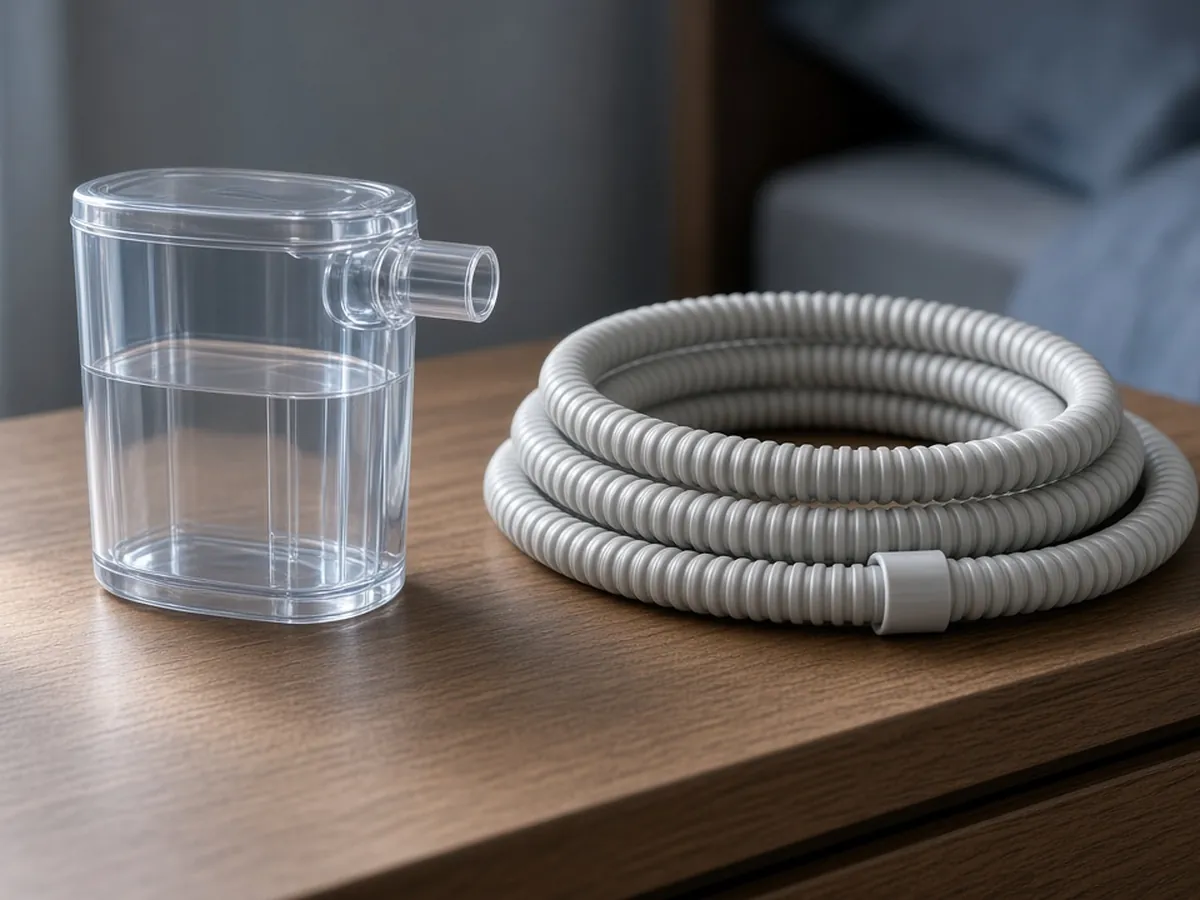
Heat is almost always the story:
- Device only — blower and electronics; ResMed’s AirSense 10 test shows 7 W.
- Add humidifier — heater plate warms water; same ResMed test jumps to 22 W.
- Add ClimateLineAir (heated hose) — another heater in the tube; same test reaches 34 W.
ResMed’s battery guide also shows much larger 12 V current draw (and thus higher Wh for an 8-hour night) once humidifier and ClimateLineAir are enabled. For camping or outages, the biggest runtime levers are usually:
- Turn heated hose off (or lower tube temperature) if clinically acceptable.
- Lower humidity level or skip the water tub for short backup nights if your clinician agrees.
- Keep mask leaks low so the blower does not work harder than needed.
Never change therapy pressure or disable humidification for power reasons without clinician guidance if dryness or other symptoms are a problem.
Overnight Wh estimate
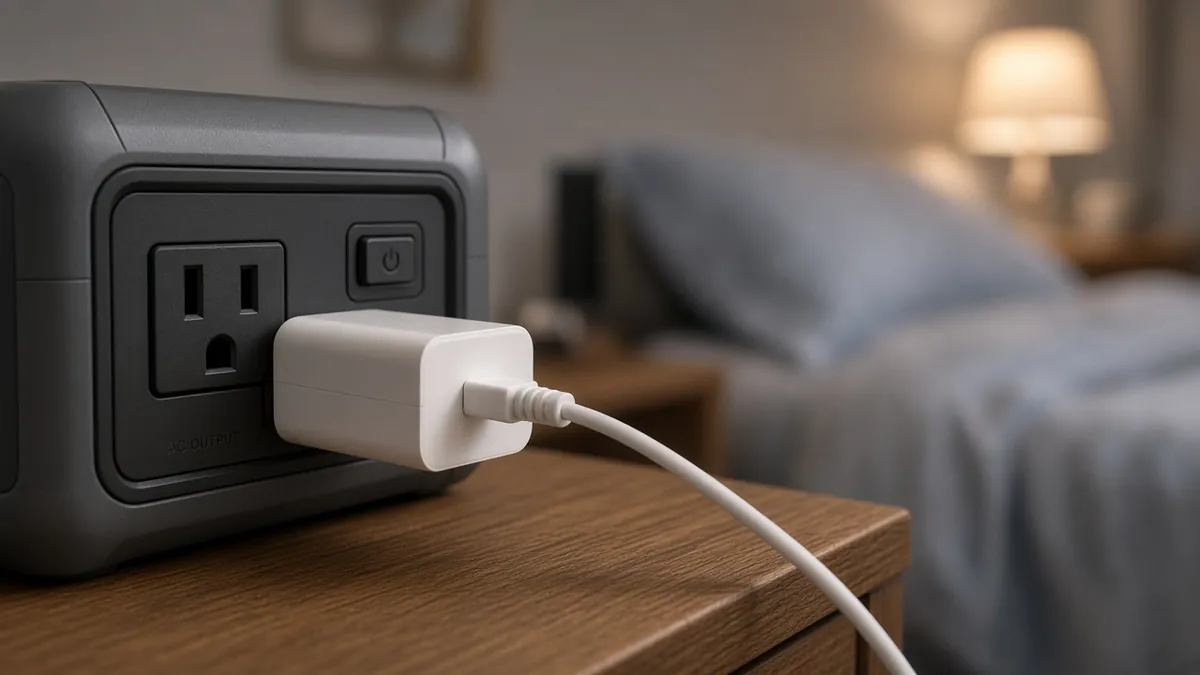
Wh for one night ≈ average watts × hours asleep.
Examples using ResMed’s AirSense 10 measured running watts (8-hour night, no station overhead yet):
| Average W (example) | 8-hour night | Rough meaning |
|---|---|---|
| 7 W (device only) | ~56 Wh | Easy on a small battery |
| 22 W (+ humidifier) | ~176 Wh | Mid-size station territory |
| 34 W (+ humidifier + heated hose) | ~272 Wh | Plan more Wh or lower climate settings |
On a portable power station AC outlet, add:
- Inverter / conversion losses (planning default often ~15% → use 85% efficiency).
- Station self-consumption while AC is on (often cited around 15 W on some Bluetti formulas; Jackery lists 18 W standby on Explorer 1000 v2—check your model).
- A reserve (often 10%) so you are not planning to 0%.
Worked planning example (humidifier + heated hose at 34 W, 8 h, 1,000 Wh station):
- Load energy: 34 W × 8 h = 272 Wh.
- Add ~15 W station overhead → effective load ≈ 49 W → 49 × 8 = 392 Wh from the battery side of the inverter.
- Usable energy ≈ 1,000 × 0.85 × 0.90 = 765 Wh.
- Hours ≈ 765 ÷ 49 ≈ 15.6 h (about two nights of margin at that load)—or plug your numbers into the runtime calculator.
If you instead use a manufacturer-approved DC cable into the CPAP (skipping the station’s AC inverter and often the CPAP’s AC brick), efficiency usually improves. Only use documented voltage, connector, and polarity.
Runtime tips with a power station
For how to match ports, surge, and camping setups, see the existing portable power station for CPAP guide. This page stays on watts and Wh.
Practical tips
- Meter one real night (or a few hours with your usual climate settings) with a plug-in watt meter or the station’s watt display.
- Disable low-load / eco auto-off if the manual says it can cut AC under small loads—CPAPs can look “too small” to some stations.
- Prefer pure sine wave AC when using the wall wart; see pure sine wave portable power station.
- Start from a full charge and keep reserve for a second night or a phone charge.
- Test the full chain (mask, hose, humidifier, cable, station) at home before an outage or trip.
- Temperature matters: cold batteries deliver less; follow the station’s operating range.
DC cable vs AC inverter: when to use which
| Path | Pros | Cons / constraints |
|---|---|---|
| AC outlet → CPAP power brick | Works with the stock supply; simplest compatibility check | Inverter losses + brick losses; station standby draw |
| Manufacturer-approved DC converter / battery kit | Often better Wh per night; designed for the device | Must match model, voltage, polarity, and humidifier limits |
Use AC when you do not have an approved DC accessory, you are verifying a new station, or the manual only documents the wall supply.
Use DC when ResMed/Philips (or your OEM) lists a compatible converter or battery for your exact model and you need maximum nights per charge—especially with humidifier off or climate settings reduced.
USB-C or random “12 V” tips are not safe just because the plug fits. Confirm the path in the CPAP and accessory manuals.
FAQ
How many watts does a CPAP machine use?
How many watts does a CPAP use with a humidifier?
How many watts does a ResMed AirSense use?
How many watts does a Philips DreamStation use?
How many Wh does a CPAP use overnight?
How long will a 500Wh or 1000Wh power station run a CPAP?
Is a CPAP a big load for a power station?
Related guides
- Portable power station for CPAP — ports, camping, and sizing checklist
- Portable power station runtime calculator
- Pure sine wave portable power station
- Portable power station wattage calculator
- Portable power station for electric blanket — another overnight load
Sources
- ResMed, AirSense 10 user guide (90 W PSU: typical 53 W / peak 104 W; DC 24 V 3.75 A). https://document.resmed.com/documents/products/machine/airsense-series/user-guide/airsense-10-device-with-humidifier_user-guide_amer_fre.pdf
- ResMed, Power consumption of Air10 devices (AirSense 10 AutoSet running: 7 / 22 / 34 W). https://document.resmed.com/documents/products/machine/air10-lumis-series/Power+consumption+Air10+devices.pdf
- ResMed, AirSense 11 user guide (65 W PSU: typical 56.1 W / peak 73.2 W; DC 24 V 2.71 A). https://document.resmed.com/documents/products/machine/airsense-11/user-guide/airsense11_user-guide_amer_mul.pdf
- ResMed, Air10 DC/DC Converter 90W user guide (typical 51 W / peak 106 W; humidifier drain warning). https://document.resmed.com/documents/products/accessory/air-10-s9-90w-dc-converter/user-guide/air10-s9-dc-converter-90w_user-guide_glo_mul.pdf
- ResMed, Battery guide (8-hour deep-cycle sizing by pressure and humidifier/ClimateLineAir). https://document.resmed.com/documents/articles/198103_battery-guide_glo_eng.pdf
- Philips Respironics, DreamStation CPAP / Auto CPAP user manual (80 W PSU; AC 100–240 VAC 2.0–1.0 A; DC 12 VDC 6.67 A). https://www.philips.com/c-dam/b2bhc/master/landing-pages/src/update/replacement-devices/dreamstation/en-us/philips-dreamstation-cpap-auto-cpap-user-manual.pdf
- Philips Respironics, DreamStation humidifier / accessory documentation (80 W supply with humidification).
- Bluetti AC180 FAQ (~15 W self-consumption in runtime formula); Jackery Explorer 1000 v2 basic information (18 W standby)—for station overhead context only.
Planning guide · United States context · Published October 7, 2026. Not medical advice. Product lines and manuals change; verify your exact model before relying on backup power.